
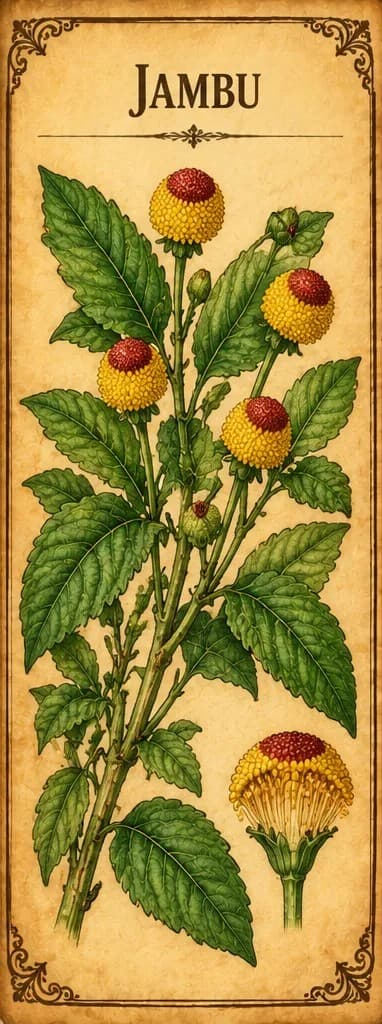
Jambu
Acmella oleracea
The "toothache plant" of Brazil, whose flower buds cause a tingling, numbing feeling in the mouth. It's used as a spice and traditionally to ease tooth pain.
Safety at a glance
- PregnancyNothing recorded
- BreastfeedingNothing recorded
- MedicinesNothing recorded
- Who should avoid itNothing recorded
- AllergiesNothing recorded
- ToxicityNothing recorded
Tap a box to read the safety notes below. “Nothing recorded” means our sources don't cover it, not that it's safe.
What is Jambu?
- Plant family
- Asteraceae, the daisy family
- Parts used
- The flower heads, leaves and roots
- Where it grows
- Brazil and other tropical and subtropical regions
- Genus
- Acmella
- Species
- oleracea
Also called
Toothache Plant, Paracress
Older scientific names
Spilanthes oleracea
Traditionally used for
- Toothache
- Spice
- Inflammation
Traditionally described as
- Numbing
- May relieve pain
Natural compounds
What does the research say?
Traditional use
These are traditional uses, not proven treatments.
Jambu, the "toothache plant", is traditionally used in Brazil and other warm regions to relieve tooth pain and inflammation, and as a culinary spice.[1]Study
Laboratory & animal research
Lab and animal results show what might be worth studying in people. They don't show that the herb has these effects in humans.
About 120 compounds have been found in jambu; the main active group is alkylamides such as spilanthol. In lab studies it has numbing, pain-relieving and antioxidant effects, may help reduce inflammation and kills some microbes.[1]Study
In mice given a cancer drug that causes nerve pain, extracts of the leaves and roots eased the pain, and larger doses worked better. In lab tests, they protected nerve cells from the drug.[2]Study
Technical detail: oxaliplatin model; 200–1200 mg/kg intraperitoneally; cold plate test; SH-SY5Y cells.
Research in people
In a trial, 72 people having their teeth bleached received a jambu film, a standard desensitizing gel or a placebo before each session. The jambu group had the least tooth sensitivity over 21 days, and whitening still worked.[3]Study
Technical detail: 35% hydrogen peroxide; comparator 5% potassium nitrate + 2% sodium fluoride; VAS, P < .001.
In a trial of 40 volunteers, adding jambu extract to a numbing cream for the gums worked moderately well, but not as well as the standard cream alone. None of the creams numbed the teeth themselves.[4]Study
Technical detail: lidocaine 2.5% + prilocaine 2.5% + jambu extract 20% (7.5% spilanthol); randomized, blinded crossover.
In short
No safety studies were found.
Sources
- [1] Botany, Ethnopharmacology, Phytochemistry, and Biological Activities of Acmella oleracea: A Comprehensive Review · DOI: 10.3390/molecules31040677Peer-reviewed study
- [2] Neuroprotective Potential of Acmella oleracea Aerial Parts and Root Extracts: The Role of Phenols and Alkylamides Against Neuropathic Pain · DOI: 10.3390/nu17162588Peer-reviewed study
- [3] Effect of Acmella Oleracea (Jambu) Bioadhesive Film on Post-Bleaching Dental Sensitivity: A Randomised Clinical Trial · DOI: 10.1016/j.identj.2026.109719Peer-reviewed study
- [4] Efficacy of lidocaine-prilocaine combined with amitriptyline or Acmella oleracea in a liposomal cream for topical anesthesia: a randomized crossover clinical trial · DOI: 10.17245/jdapm.2025.25.6.409Peer-reviewed study
This information is educational and traditional in nature, and is not a substitute for professional medical advice. Unfamiliar word? See what these words mean.