
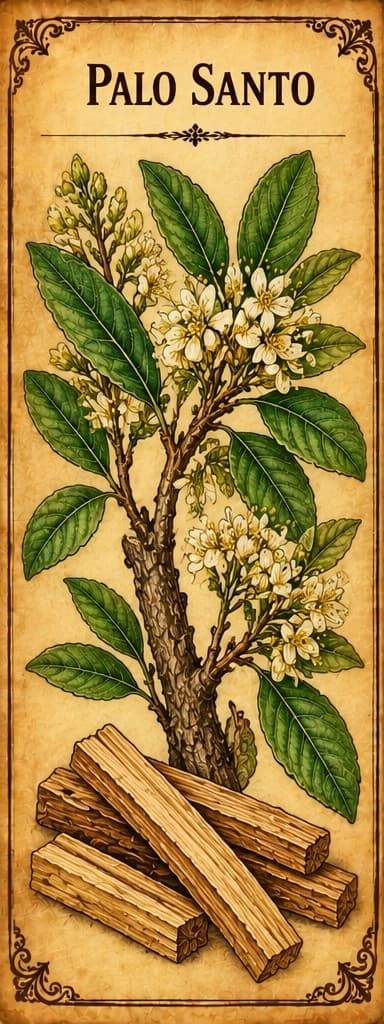
Palo Santo
Bursera graveolens
A fragrant tree from dry forests of Mexico to Peru whose wood is burned as incense. Lab studies of its essential oil, which is mostly limonene, found it killed some microbes and repelled mosquitoes.
Safety at a glance
- PregnancyNothing recorded
- BreastfeedingNothing recorded
- MedicinesNothing recorded
- Who should avoid itNothing recorded
- AllergiesNothing recorded
- ToxicityNothing recorded
Tap a box to read the safety notes below. “Nothing recorded” means our sources don't cover it, not that it's safe.
What is Palo Santo?
- Plant family
- Burseraceae, the frankincense and myrrh family
- Parts used
- The fragrant wood, burned as incense, and its essential oil
- Where it grows
- Dry forests from Mexico to northwestern Venezuela and Peru
- Genus
- Bursera
- Species
- graveolens
Also called
Holy Wood
Traditionally used for
- Incense
- Insect repellent
Traditionally described as
- Fragrant
- Repels mosquitoes
- Antifungal (in lab studies)
Natural compounds
What does the research say?
Traditional use
These are traditional uses, not proven treatments.
Sticks of palo santo wood are sold to burn as incense, often in "energy cleansing" kits alongside white sage. Some sellers know about overharvesting and illegal harvesting but sell it because customers ask for it.[1]Study
Laboratory & animal research
Lab and animal results show what might be worth studying in people. They don't show that the herb has these effects in humans.
The essential oil is mostly limonene. In lab and mouse tests, it was well tolerated on the skin, killed Candida yeasts and reduced skin swelling.[2]Study
In mice, the oil reduced pain responses and showed no signs of liver damage. In lab tests, it killed Staphylococcus aureus bacteria, including the drug-resistant strain MRSA.[3]Study
Technical detail: D-limonene 38.7%; acetic acid writhing and formalin tests; nanoemulsion form.
Research in people
Put on people's skin, palo santo oil repelled tiger mosquitoes for more than 45 minutes, about as well as DEET did in the first 15 minutes. It also stopped mosquitoes laying eggs. People found its smell less pleasant than lemon verbena oil.[4]Study
Technical detail: 0.20 µL/cm²; RD50 0.136 µL/cm²; 64% fewer eggs at 200 µL/L.
In short
Demand for the wood has raised concerns about overharvesting and illegal harvesting.
Sources
- [1] Commercialized "Smudge Sticks" Used as Incense in the Netherlands: An Inventory of Plants and Trends Behind a New Age Fashion · DOI: 10.3390/plants13213003Peer-reviewed study
- [2] Therapeutic Applications of Essential Oils from Native and Cultivated Ecuadorian Plants: Cutaneous Candidiasis and Dermal Anti-Inflammatory Activity · DOI: 10.3390/molecules28155903Peer-reviewed study
- [3] Palo Santo (Bursera graveolens) essential oil nanoemulsion: toxicological, antinociceptive and antimicrobial potential against bovine mastitis-associated strains · DOI: 10.1007/s10482-026-02322-wPeer-reviewed study
- [4] Chemical Profiling, Sensory Qualities, and Bioactivities of Essential Oils Obtained from Aloysia citrodora and Bursera graveolens Ecuadorian Plants Against the Mosquito Aedes albopictus (Skuse) (Diptera: Culicidae) · DOI: 10.3390/insects16020202Peer-reviewed study
This information is educational and traditional in nature, and is not a substitute for professional medical advice. Unfamiliar word? See what these words mean.