
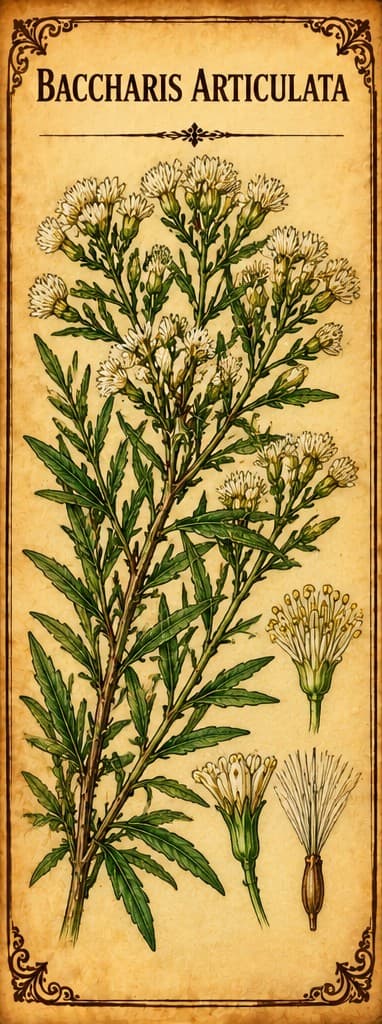
Baccharis Articulata
Baccharis articulata
A carqueja, a shrub with flat winged stems from southern Brazil, used in folk medicine for weight loss, digestion and liver problems. It has only been studied in the lab.
Safety at a glance
- PregnancyNothing recorded
- BreastfeedingNothing recorded
- MedicinesNothing recorded
- Who should avoid itNothing recorded
- AllergiesNothing recorded
- ToxicityNothing recorded
Tap a box to read the safety notes below. “Nothing recorded” means our sources don't cover it, not that it's safe.
What is Baccharis Articulata?
- Plant family
- Asteraceae, the daisy family
- Parts used
- The winged green stems and other above-ground parts
- Where it grows
- Southern Brazil, Uruguay and Argentina
- Genus
- Baccharis
- Species
- articulata
Regional names
Carqueja
Traditionally used for
- Weight loss
- Digestion
- Liver problems
- Increasing urination
Traditionally described as
- Antioxidant (in lab studies)
Natural compounds
What does the research say?
Traditional use
These are traditional uses, not proven treatments.
In southern Brazil, this carqueja is widely used for weight loss and for digestive and liver problems.[1]Study
Several Baccharis species are sold as "carqueja" and are used for digestion and to increase urination. They're often confused with each other, so the plant you buy may not be this species.[2]Study
Laboratory & animal research
Lab and animal results show what might be worth studying in people. They don't show that the herb has these effects in humans.
In lab tests on mouse liver cells involved in scarring, a water extract calmed the cells and reduced the scar protein collagen, without harming them. Chlorogenic acid in the extract may be partly responsible.[1]Study
Technical detail: GRX hepatic stellate cells; reduced TGF-β1; 26 metabolites identified.
In lab tests, a carqueja tea had strong antioxidant activity and cut fat build-up in human liver cells by about half.[3]Study
Technical detail: 86% DPPH inhibition; HepG2 cells loaded with oleic acid as a fatty liver model.
In short
Several carqueja species look alike and are often mixed up.
Sources
- [1] Baccharis articulata aqueous extract exerts in vitro antifibrotic effect in hepatic stellate cells by attenuating collagen deposition and TGF-ß1 protein expression · DOI: 10.17179/excli2025-8394Peer-reviewed study
- [2] Authentication and Quality Control of the Brazilian Traditional Herb 'Carquejas' (Baccharis Species) Using Morpho-Anatomy and Microscopy · DOI: 10.3390/plants13213030Peer-reviewed study
- [3] Antioxidant Capacity and Inhibition of Lipid Accumulation Effect of Baccharis articulata and Citrus sinensis Infusions · DOI: 10.1007/s11130-025-01452-2Peer-reviewed study
This information is educational and traditional in nature, and is not a substitute for professional medical advice. Unfamiliar word? See what these words mean.