
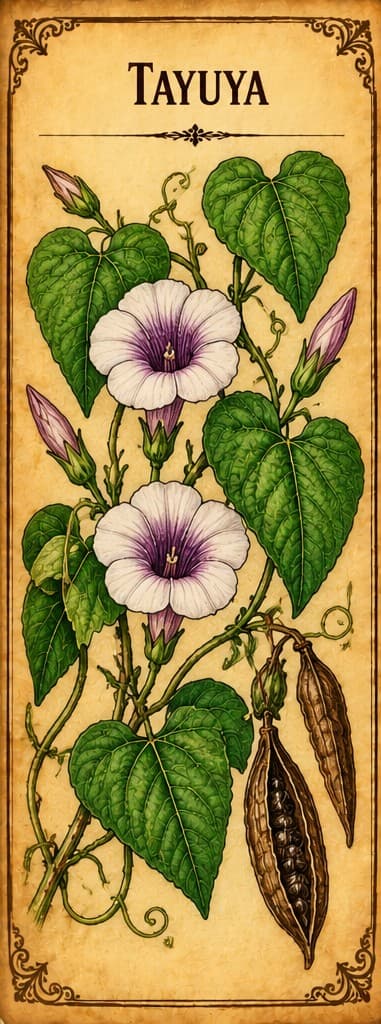
Tayuya
Cayaponia tayuya
A climbing vine of the gourd family whose large root is used in Brazil, Peru and Colombia for inflammation and rheumatism. It has only been studied in mice and the lab.
Safety at a glance
- PregnancyNothing recorded
- BreastfeedingNothing recorded
- MedicinesNothing recorded
- Who should avoid itNothing recorded
- AllergiesNothing recorded
- ToxicityNothing recorded
Tap a box to read the safety notes below. “Nothing recorded” means our sources don't cover it, not that it's safe.
What is Tayuya?
- Plant family
- Cucurbitaceae, the gourd and cucumber family
- Parts used
- The large swollen root
- Where it grows
- Brazil, Peru and Colombia
- Genus
- Cayaponia
- Species
- tayuya
Regional names
Taiuiá
Traditionally used for
- Inflammation
- Rheumatism
Traditionally described as
- May help reduce inflammation (in animal studies)
Natural compounds
What does the research say?
Traditional use
These are traditional uses, not proven treatments.
Tayuya is a climbing vine with a large swollen root. In the folk medicine of Brazil, Peru and Colombia, the root is used to reduce inflammation and for rheumatism.[1]Study
Laboratory & animal research
Lab and animal results show what might be worth studying in people. They don't show that the herb has these effects in humans.
Flavonoids from the root, applied to swollen mouse ears, reduced the swelling by 66% after a single application and by 37% in longer-lasting inflammation. In lab tests, they blocked enzymes that drive inflammation.[1]Study
Technical detail: TPA-induced ear oedema, 0.5 mg/ear; inhibited iNOS (98%) and COX-2 (49%) expression in RAW 264.7 macrophages.
In short
No studies in people or safety studies were found.
Sources
- [1] Anti-inflammatory activity of flavonoids from Cayaponia tayuya roots · DOI: 10.1016/j.jep.2008.11.002Peer-reviewed study
This information is educational and traditional in nature, and is not a substitute for professional medical advice. Unfamiliar word? See what these words mean.