
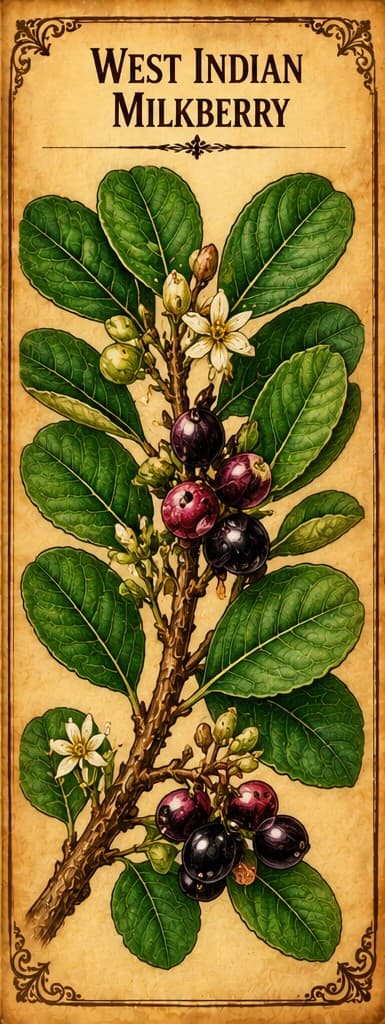
West Indian Milkberry
Chiococca alba
A tropical American shrub, called cainca in Brazil, used by Maya healers for fever and rheumatism. In lab tests its root blocked two mosquito-borne viruses.
Safety at a glance
- PregnancyNothing recorded
- BreastfeedingNothing recorded
- MedicinesNothing recorded
- Who should avoid itNothing recorded
- AllergiesNothing recorded
- ToxicityNothing recorded
Tap a box to read the safety notes below. “Nothing recorded” means our sources don't cover it, not that it's safe.
What is West Indian Milkberry?
- Plant family
- Rubiaceae, the coffee family
- Parts used
- The roots and wood
- Where it grows
- The tropical Americas, from Florida and the Caribbean to South America
- Genus
- Chiococca
- Species
- alba
Also called
Snowberry
Regional names
Cainca, Caninana
Traditionally used for
- Fever
- Rheumatism
- Appetite suppression
- Increasing urination
Traditionally described as
- Antiviral (in lab studies)
Natural compounds
Safety
Contamination
Brazilian samples of the wood contained lead above the US Pharmacopeia limit. A tea made from 40 g of the wood with another plant contained more cadmium than the daily safe limit.[1]Study
What does the research say?
Traditional use
These are traditional uses, not proven treatments.
Laboratory & animal research
Lab and animal results show what might be worth studying in people. They don't show that the herb has these effects in humans.
In lab tests, two root extracts blocked more than 70% of the activity of chikungunya and Mayaro viruses, which cause fever and joint pain.[2]Study
Technical detail: 60 µg/mL in Vero cells; flavonoids naringin and vitexin predicted to bind the viral nsP2 protease.
In lab tests, root extracts killed the larvae of Aedes aegypti, the mosquito that spreads dengue, and repelled adult mosquitoes. They didn't harm a water bug that eats mosquito larvae.[3]Study
Technical detail: methanolic extract, LC50 82 mg/mL; 18 compounds including rutin, naringin and quercetin.
In short
Brazilian samples have contained lead and cadmium above safe limits.
Sources
- [1] The Hazardous Level of Heavy Metals in Different Medicinal Plants and Their Decoctions in Water: A Public Health Problem in Brazil · DOI: 10.1155/2020/1465051Peer-reviewed study
- [2] Antiviral Potential of Chiococca alba (L.) Hitchc. Plant Extracts Against Chikungunya and Mayaro Viruses · DOI: 10.3390/ijms252111397Peer-reviewed study
- [3] Methanolic Extracts of Chiococca alba in Aedes aegypti Biorational Management: Larvicidal and Repellent Potential, and Selectivity against Non-Target Organisms · DOI: 10.3390/plants11233298Peer-reviewed study
This information is educational and traditional in nature, and is not a substitute for professional medical advice. Unfamiliar word? See what these words mean.