
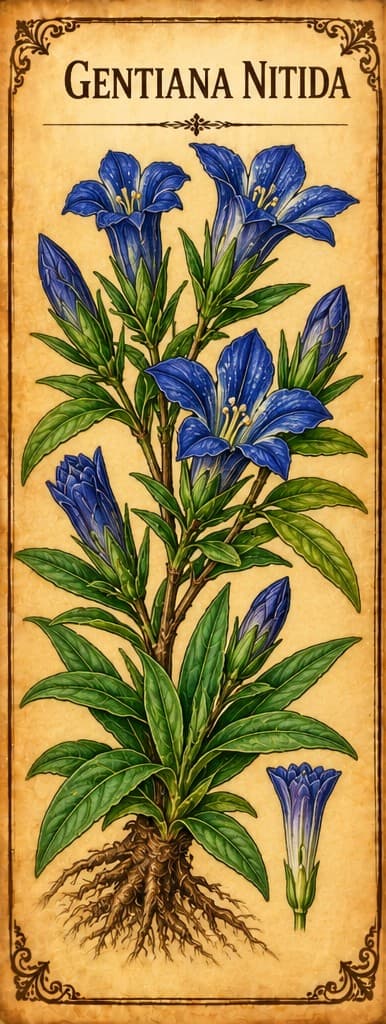
Gentiana Nitida
Gentianella nitida
A small Andean gentian sold in Peruvian markets as "hercampuri", mainly as a remedy for diabetes. It hasn't been studied for its effects or safety.
Safety at a glance
- PregnancyNothing recorded
- BreastfeedingNothing recorded
- MedicinesNothing recorded
- Who should avoid itNothing recorded
- AllergiesNothing recorded
- ToxicityNothing recorded
Tap a box to read the safety notes below. “Nothing recorded” means our sources don't cover it, not that it's safe.
What is Gentiana Nitida?
- Plant family
- Gentianaceae, the gentian family
- Parts used
- The whole plant, dried and ground
- Where it grows
- The Andes of Peru
- Genus
- Gentianella
- Species
- nitida
Regional names
Hercampuri
Older scientific names
Gentianella nitida
Traditionally used for
- Diabetes
Traditionally described as
- Bitter
Natural compounds
Safety
Contamination
Hercampuri sold in Peruvian markets may be any of several gentian species, and none of them has been tested for safety or a safe dose.[1]Study
What does the research say?
Traditional use
These are traditional uses, not proven treatments.
In Peru, several gentian species are sold as "hercampuri". At a Lima market, this was the species most often sold under that name, as a remedy for diabetes. Different species are sold under the same name, and neither collectors nor sellers reliably tell them apart.[1]Study
Laboratory & animal research
Lab and animal results show what might be worth studying in people. They don't show that the herb has these effects in humans.
Chemists have found bitter compounds called secoiridoid glucosides in it, including a new one named amaronitidin.[2]Study
In short
Several gentian species are sold as hercampuri, and none has been tested for safety.
Sources
- [1] Peril in the market-classification and dosage of species used as anti-diabetics in Lima, Peru · DOI: 10.1186/1746-4269-9-37Peer-reviewed study
- [2] A new secoiridoid glucoside, amaronitidin, from the Peruvian folk medicine "Hercampuri" (Gentianella nitida) · DOI: 10.1248/cpb.49.771Peer-reviewed study
This information is educational and traditional in nature, and is not a substitute for professional medical advice. Unfamiliar word? See what these words mean.