
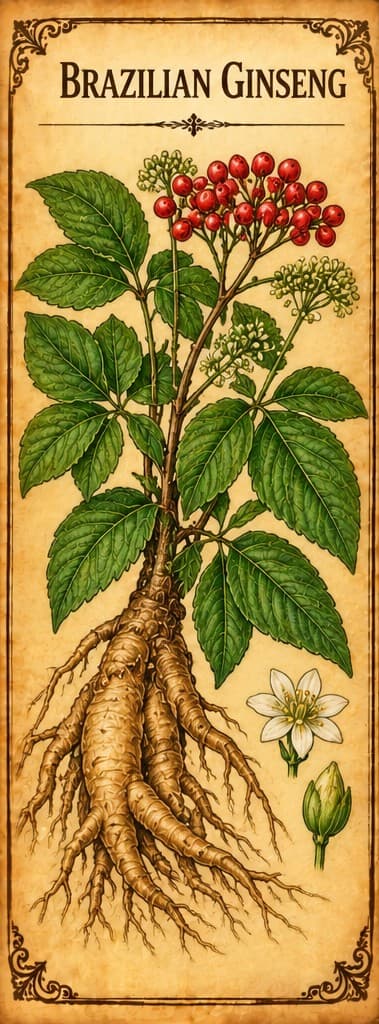
Brazilian Ginseng
Hebanthe eriantha
Suma, a South American root used in folk medicine and sold as a supplement, nicknamed "cure-everything" in Brazil. It isn't related to true ginseng and has only been studied in the lab.
Safety at a glance
- PregnancyNothing recorded
- BreastfeedingNothing recorded
- MedicinesNothing recorded
- Who should avoid itNothing recorded
- AllergiesNothing recorded
- ToxicityNothing recorded
Tap a box to read the safety notes below. “Nothing recorded” means our sources don't cover it, not that it's safe.
What is Brazilian Ginseng?
- Plant family
- Amaranthaceae, the amaranth family
- Parts used
- The root
- Where it grows
- Brazil and other parts of South America
- Genus
- Hebanthe
- Species
- eriantha
Also called
Suma
Older scientific names
Pfaffia paniculata
Traditionally used for
- General tonic
Traditionally described as
- Antimicrobial (in lab studies)
Natural compounds
What does the research say?
Traditional use
These are traditional uses, not proven treatments.
Suma is used in folk medicine and is sold commercially. In Brazil it's nicknamed "cure-everything", though its proven effects are limited.[1]Study
Laboratory & animal research
Lab and animal results show what might be worth studying in people. They don't show that the herb has these effects in humans.
In lab tests, a root extract killed colon and breast cancer cells, slowed some bacteria, and was moderately toxic to brine shrimp.[2]Study
Technical detail: IC50 272.6 µg/mL (HCT116) and 88.5 µg/mL (4T1) at 72 h; Artemia salina LC50 589.4 µg/mL.
In lab tests, a root extract weakened films of Candida yeast and of bacteria involved in tooth decay and infections. It also harmed human gum cells at higher doses.[1]Study
Technical detail: Candida spp., Streptococcus mutans and Pseudomonas aeruginosa biofilms; FMM-1 fibroblast viability 55–66%.
In short
No studies in people or safety studies were found.
Sources
- [1] Pfaffia paniculata Extract, a Potential Antimicrobial Agent against Candida spp., Pseudomonas aeruginosa, and Streptococcus mutans Biofilms · DOI: 10.3390/microorganisms12061165Peer-reviewed study
- [2] Antiproliferative assay of suma or Brazilian ginseng (Hebanthe eriantha) methanolic extract on HCT116 and 4T1 cancer cell lines, in vitro toxicity on Artemia salina larvae, and antibacterial activity · DOI: 10.1080/14786419.2023.2225688Peer-reviewed study
This information is educational and traditional in nature, and is not a substitute for professional medical advice. Unfamiliar word? See what these words mean.