
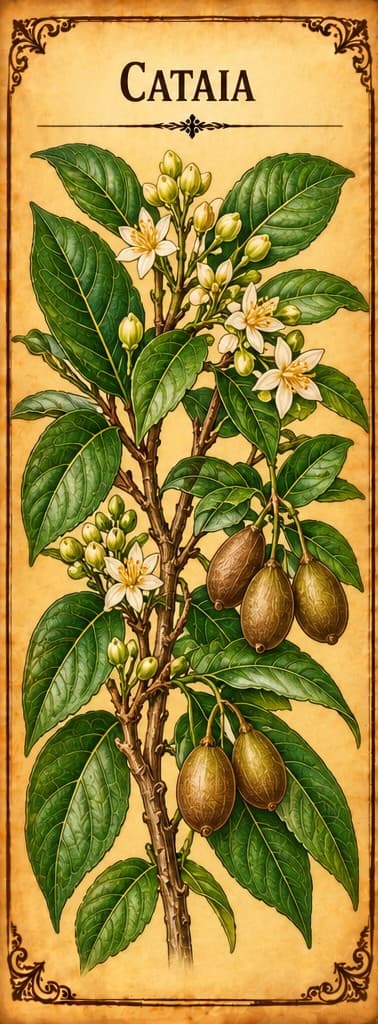
Cataia
Pimenta pseudocaryophyllus
A clove-scented Brazilian tree whose leaf tea is a folk remedy for emotional tension, as an aphrodisiac and to increase urination. In mice, its leaves reduced anxiety and inflammatory pain.
Safety at a glance
- PregnancyNothing recorded
- BreastfeedingNothing recorded
- MedicinesNothing recorded
- Who should avoid itNothing recorded
- AllergiesNothing recorded
- ToxicityNothing recorded
Tap a box to read the safety notes below. “Nothing recorded” means our sources don't cover it, not that it's safe.
What is Cataia?
- Plant family
- Myrtaceae, the myrtle family
- Parts used
- The leaves, usually as a tea
- Where it grows
- Brazil
- Genus
- Pimenta
- Species
- pseudocaryophyllus
Regional names
Craveiro, Louro-Cravo
Traditionally used for
- Emotional tension
- Aphrodisiac
- Increasing urination
Traditionally described as
- Calming (in animal studies)
- May relieve pain (in animal studies)
- Antimicrobial (in lab studies)
Natural compounds
What does the research say?
Traditional use
These are traditional uses, not proven treatments.
In Brazilian folk medicine, a tea of cataia leaves has long been used to increase urination, as an aphrodisiac and as a calming drink for emotional tension.[1]Study
Laboratory & animal research
Lab and animal results show what might be worth studying in people. They don't show that the herb has these effects in humans.
In mice, a leaf extract given by mouth reduced anxious behavior. The effect appeared to work through serotonin rather than the way Valium-type drugs work.[1]Study
Technical detail: dichloromethane fraction; light-dark box and elevated plus maze; blocked by the 5-HT1A antagonist NAN-190, not by flumazenil.
In mice, the leaf oil at a moderate dose reduced anxious behavior without affecting balance. At a much higher dose, the calming effect reversed and coordination was slightly affected.[2]Study
Technical detail: 100 mg/kg anxiolytic-like in the elevated plus maze; 500 mg/kg reduced open-arm entries; rotarod.
In mice, an extract strongly reduced pain caused by inflammation, without affecting movement.[3]Study
Technical detail: 3 mg/kg intraperitoneally; reduced neutrophil recruitment, oxidative stress, TNF-α and IL-1β.
In lab tests, the leaf oil killed Candida yeast and several bacteria. Plants from different places had different main compounds (eugenol or methyl eugenol).[4]Study
In short
No studies in people or safety studies were found.
Sources
- [1] Involvement of 5-HT1A in the anxiolytic-like effect of dichloromethane fraction of Pimenta pseudocaryophyllus · DOI: 10.1016/j.jep.2012.03.043Peer-reviewed study
- [2] Anxiolytic Potential of Selected Essential Oils and Their Impact on Motor Function · DOI: 10.3390/ijms27198786Peer-reviewed study
- [3] Pimenta pseudocaryophyllus (Gomes) Landrum extract inhibits inflammatory pain in mice: targeting neutrophil recruitment, oxidative stress, and cytokine production · DOI: 10.1080/14786419.2022.2045487Peer-reviewed study
- [4] Antimicrobial activity of the essential oil from two specimens of Pimenta pseudocaryophyllus (Gomes) L.R. Landrum (Myrtaceae) native from São Paulo State, BrazilPeer-reviewed study
This information is educational and traditional in nature, and is not a substitute for professional medical advice. Unfamiliar word? See what these words mean.