
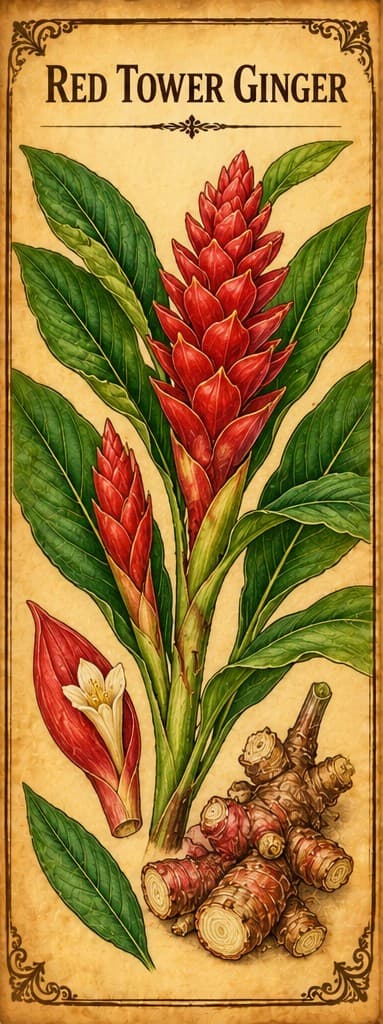
Red Tower Ginger
Costus comosus
An Ecuadorian plant with tall red flower cones, traditionally used for fever, asthma, worms, diabetes and liver problems. Its stem has only been studied in the lab.
Safety at a glance
- PregnancyNothing recorded
- BreastfeedingNothing recorded
- MedicinesNothing recorded
- Who should avoid itNothing recorded
- AllergiesNothing recorded
- ToxicityNothing recorded
Tap a box to read the safety notes below. “Nothing recorded” means our sources don't cover it, not that it's safe.
What is Red Tower Ginger?
- Plant family
- Costaceae, the spiral ginger family
- Parts used
- The leaves, stems and rhizome (underground stem)
- Where it grows
- Ecuador and nearby parts of tropical South and Central America
- Genus
- Costus
- Species
- comosus
Regional names
Caña
Traditionally used for
- Fever
- Asthma
- Bronchitis
- Intestinal worms
- Diabetes
- Liver problems
Traditionally described as
- May lower blood sugar (in lab studies)
Natural compounds
What does the research say?
Traditional use
These are traditional uses, not proven treatments.
In Ecuador, the leaves and rhizome have traditionally been used for:
- fever and rashes
- asthma and bronchitis
- intestinal worms
- diabetes
- liver diseases
The stem is boiled into a decoction.[1]Study
Laboratory & animal research
Lab and animal results show what might be worth studying in people. They don't show that the herb has these effects in humans.
In lab tests, a stem extract blocked an enzyme that breaks down starch into sugar, more strongly than the diabetes drug acarbose did.[1]Study
Technical detail: methanolic extract α-glucosidase IC50 57.9 µg/mL vs acarbose 964.6 µg/mL.
In short
No studies in people or safety studies were found.
Sources
- [1] Exploring Folklore Ecuadorian Medicinal Plants and Their Bioactive Components Focusing on Antidiabetic Potential: An Overview · DOI: 10.3390/plants13111436Peer-reviewed study
This information is educational and traditional in nature, and is not a substitute for professional medical advice. Unfamiliar word? See what these words mean.