
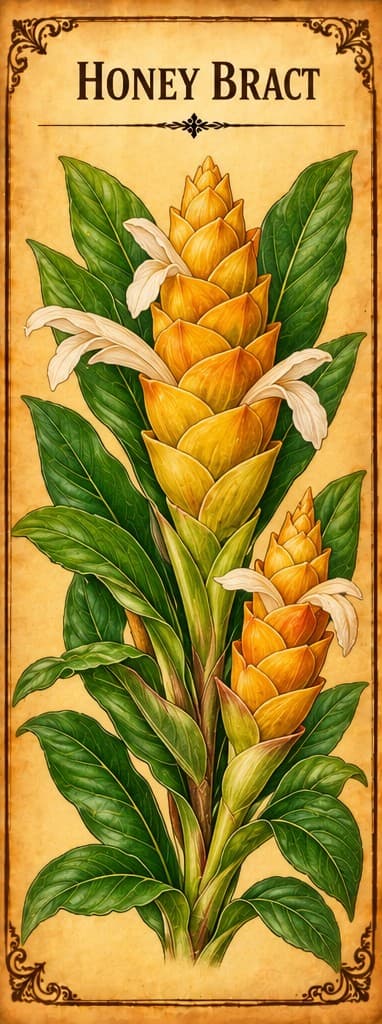
Honey Bract
Renealmia alpinia
A wild ginger relative from tropical America used in folk medicine for snakebites. A compound from it blocked a rattlesnake venom toxin in mice.
Safety at a glance
- PregnancyNothing recorded
- BreastfeedingNothing recorded
- MedicinesNothing recorded
- Who should avoid itNothing recorded
- AllergiesNothing recorded
- ToxicityNothing recorded
Tap a box to read the safety notes below. “Nothing recorded” means our sources don't cover it, not that it's safe.
What is Honey Bract?
- Plant family
- Zingiberaceae, the ginger family
- Parts used
- The leaves
- Where it grows
- Tropical forests from Mexico to Brazil and the Caribbean
- Genus
- Renealmia
- Species
- alpinia
Traditionally used for
- Snakebites
Traditionally described as
- Blocks some snake venom toxins (in animal studies)
- Antioxidant
Natural compounds
What does the research say?
Traditional use
These are traditional uses, not proven treatments.
Honey bract, a wild relative of ginger, is used in folk medicine to treat snakebites.[1]Study
Laboratory & animal research
Lab and animal results show what might be worth studying in people. They don't show that the herb has these effects in humans.
In lab tests, the leaf oil showed strong antioxidant activity. Its main compounds were alpha-phellandrene and beta-caryophyllene.[2]Study
Pinostrobin, a compound from the plant, blocked a rattlesnake venom toxin. In mice, mixing it with the toxin before injection prevented up to 87% of the muscle damage, and it also reduced swelling. It worked less well when given after the toxin.[1]Study
Technical detail: phospholipase A2 from Crotalus durissus cumanensis venom; IC50 about 1.8 mM; 56% inhibition when injected after the toxin.
In short
It hasn't been tested as a snakebite treatment in people.
Sources
- [1] Inhibitory effect of pinostrobin from Renealmia alpinia, on the enzymatic and biological activities of a PLA2 · DOI: 10.1016/j.ijbiomac.2016.04.042Peer-reviewed study
- [2] Chemical composition and antioxidant activity of the essential oil of Renealmia alpinia (Rottb.) Maas · DOI: 10.1080/14786419.2022.2164578Peer-reviewed study
This information is educational and traditional in nature, and is not a substitute for professional medical advice. Unfamiliar word? See what these words mean.