
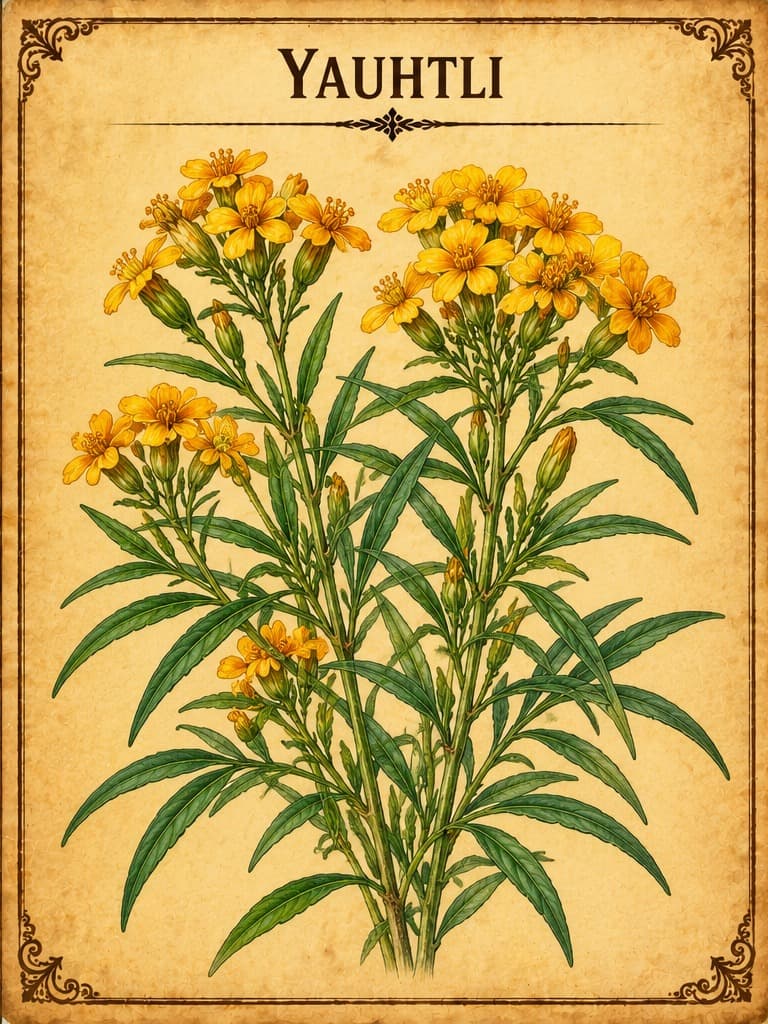
Yauhtli
Tagetes lucida
Mexican mint marigold, a fragrant golden-flowered herb used in Mexico for rheumatic pain and nervous-system problems. In animal studies it eased gout pain and calmed psychosis-like behavior.
Safety at a glance
- PregnancyNothing recorded
- BreastfeedingNothing recorded
- Medicines1 note →
- Who should avoid itNothing recorded
- AllergiesNothing recorded
- ToxicityNothing recorded
Tap a box to read the safety notes below. “Nothing recorded” means our sources don't cover it, not that it's safe.
Yauhtli may interact with some medicines. If you take any medicine, read Interactions with medicines below and talk to your doctor or pharmacist before using it.
What is Yauhtli?
- Plant family
- Asteraceae, the daisy family
- Parts used
- The leaves and flowering tops
- Where it grows
- Mexico and Central America
- Genus
- Tagetes
- Species
- lucida
Also called
Mexican Mint Marigold
Regional names
Pericón, Yerbaniz
Traditionally used for
- Rheumatic pain
- Inflammation
- Nervous disorders
Traditionally described as
- May relieve pain (in animal studies)
Natural compounds
Safety
Interactions with medicines
In mice, extracts and compounds from the plant strengthened the stiffness caused by the antipsychotic haloperidol.[1]Study
What does the research say?
Traditional use
These are traditional uses, not proven treatments.
Laboratory & animal research
Lab and animal results show what might be worth studying in people. They don't show that the herb has these effects in humans.
In rats with gout-like joint pain, a water extract relieved pain about as well as the painkiller ketorolac, and higher doses worked better. Its compound umbelliferone also eased pain. A very large single dose caused no signs of poisoning in mice.[2]Study
Technical detail: 562 mg/kg aqueous extract; umbelliferone 316 mg/kg; acute toxicity 2000 mg/kg (OECD 425).
In mice given ketamine to cause psychosis-like behavior, extracts and two of the plant's compounds blocked many of the effects, including restlessness, memory problems and reduced social contact.[1]Study
Technical detail: coumarins herniarin and dimethylfraxetin; acted on dopamine and glutamate systems.
In short
In mice, it strengthened the effects of the antipsychotic haloperidol.
Sources
- [1] Herniarin, Dimethylfraxetin and Extracts from Tagetes lucida, in Psychosis Secondary to Ketamine and Its Interaction with Haloperidol · DOI: 10.3390/plants11202789Peer-reviewed study
- [2] Antinociceptive effect of Tagetes lucida in an arthritic gout-pain model in rats · DOI: 10.1016/j.jep.2025.120718Peer-reviewed study
This information is educational and traditional in nature, and is not a substitute for professional medical advice. Unfamiliar word? See what these words mean.