
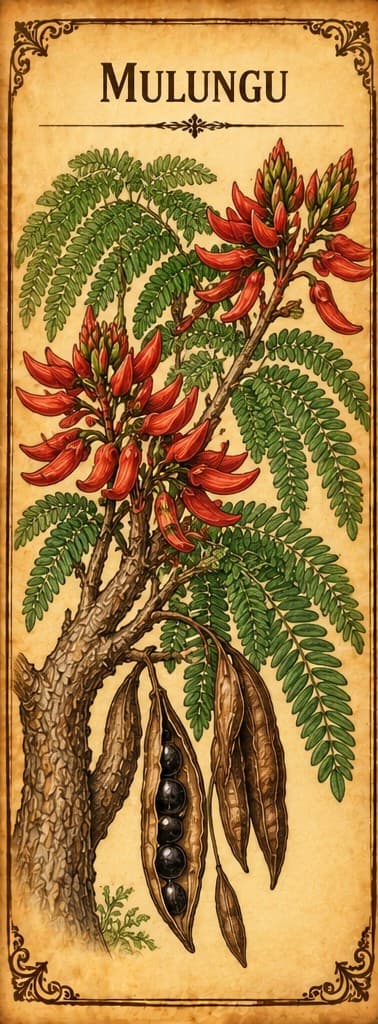
Mulungu
Erythrina mulungu
A Brazilian coral tree used traditionally for breathing problems. In a trial before dental surgery, it didn't ease anxiety better than a placebo.
Safety at a glance
- PregnancyNothing recorded
- BreastfeedingNothing recorded
- MedicinesNothing recorded
- Who should avoid itNothing recorded
- AllergiesNothing recorded
- ToxicityNothing recorded
Tap a box to read the safety notes below. “Nothing recorded” means our sources don't cover it, not that it's safe.
What is Mulungu?
- Plant family
- Fabaceae, the pea and bean family
- Parts used
- The flowers and bark
- Where it grows
- Brazil
- Genus
- Erythrina
- Species
- mulungu
Older scientific names
Erythrina verna
Traditionally used for
- Breathing problems
- Anxiety
Traditionally described as
- May ease seizures (in animal studies)
Natural compounds
What does the research say?
Traditional use
These are traditional uses, not proven treatments.
Mulungu is a native Brazilian tree used traditionally for breathing problems.[1]Study
Laboratory & animal research
Lab and animal results show what might be worth studying in people. They don't show that the herb has these effects in humans.
In mice with allergic asthma, a flower extract reduced airway over-reactivity and lung inflammation.[1]Study
Technical detail: 200–800 mg/kg intraperitoneally; ovalbumin model; reduced IL-4 and IL-5; main alkaloids erysotrine, erysotrine-N-oxide and hypaphorine.
In rats, two alkaloids from the flowers blocked up to all chemically triggered seizures, depending on the trigger, and protected the animals from death.[2]Study
Technical detail: (+)-erythravine and (+)-11-α-hydroxy-erythravine; bicuculline, pentylenetetrazole, kainic acid and NMDA models.
Research in people
In a trial of 200 people having wisdom teeth removed, 500 mg of mulungu taken an hour before surgery didn't control anxiety any better than a placebo. Passionflower worked about as well as midazolam, a prescription medicine used to calm people before procedures.[3]Study
Technical detail: randomized, placebo-controlled, triple-blind; compared with Passiflora incarnata 500 mg and midazolam 15 mg.
In short
It didn't reduce anxiety in a clinical trial.
Sources
- [1] The ethanolic extract from Erythrina mulungu Benth. flowers attenuates allergic airway inflammation and hyperresponsiveness in a murine model of asthma · DOI: 10.1016/j.jep.2018.08.009Peer-reviewed study
- [2] Anticonvulsant profile of the alkaloids (+)-erythravine and (+)-11-α-hydroxy-erythravine isolated from the flowers of Erythrina mulungu Mart ex Benth (Leguminosae-Papilionaceae) · DOI: 10.1016/j.yebeh.2010.12.037Peer-reviewed study
- [3] Herbal medicines as anxiolytics prior to third molar surgical extraction. A randomized controlled clinical trial · DOI: 10.1007/s00784-020-03468-1Peer-reviewed study
This information is educational and traditional in nature, and is not a substitute for professional medical advice. Unfamiliar word? See what these words mean.