
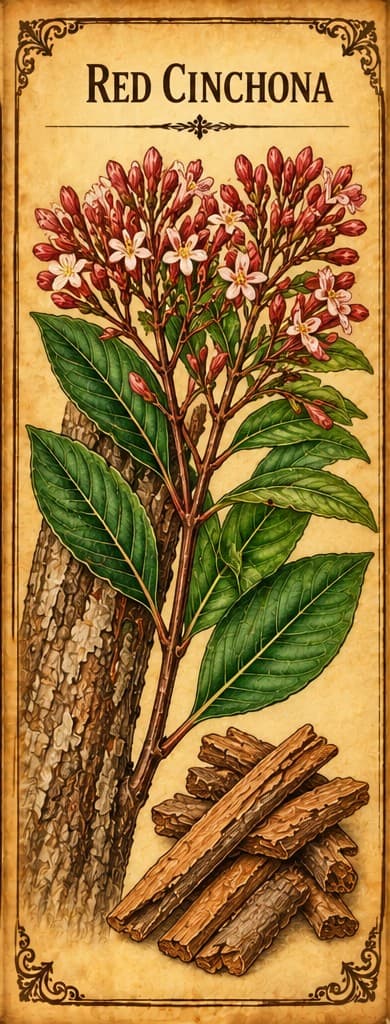
Red Cinchona
Cinchona pubescens
The Andean "fever tree" whose bark gave the world quinine, the first effective malaria treatment. Quinine is now a prescription drug with serious side effects.
Safety at a glance
- PregnancyNothing recorded
- BreastfeedingNothing recorded
- MedicinesNothing recorded
- Who should avoid it1 note →
- AllergiesNothing recorded
- Toxicity1 note →
Tap a box to read the safety notes below. “Nothing recorded” means our sources don't cover it, not that it's safe.
What is Red Cinchona?
- Plant family
- Rubiaceae, the coffee family
- Parts used
- The bark
- Where it grows
- The Andes of South America
- Genus
- Cinchona
- Species
- pubescens
Also called
Peruvian Bark, Fever Tree
Traditional names
Jesuit's Bark
Older scientific names
Cinchona succirubra
Traditionally used for
- Malaria
- Fever
Traditionally described as
- Source of quinine and quinidine
Natural compounds
Safety
Who should avoid it
Don't use quinine for leg cramps. In the US, its label carries a boxed warning against this use, and long-term quinine use has been linked to a higher risk of death.[1]Study
Side effects
Quinidine can cause dangerous heart rhythm changes in 2–8% of people who take it, as well as low platelet counts, hepatitis and lupus-like reactions.[1]Study
Toxicity testing
Quinine has a narrow margin between a helpful and a harmful dose. Mild poisoning, called cinchonism, causes ringing in the ears, some hearing loss, headache, nausea, vision changes and dizziness on standing. Larger amounts can cause vertigo, vomiting, diarrhea, marked hearing loss and loss of vision. It can also cause low blood sugar and low blood pressure.[1]Study
What does the research say?
Traditional use
These are traditional uses, not proven treatments.
Cinchona bark from South America reached Europe in the 1630s, brought by Spanish Jesuit missionaries, and became famous as a cure for malaria fevers. It was known as "Peruvian bark" and "Jesuit's powder".[1]Study
Research in people
The bark's main compounds, quinine and quinidine, became medicines. Quinine is still used for severe malaria where other drugs aren't available, and in pregnant women. Quinidine is used for some heart rhythm and nerve conditions. Both are now made as purified drugs, and their use has declined because of side effects.[1]Study
In short
Quinine can cause hearing and vision loss, low blood sugar and heart rhythm problems.
Sources
- [1] The Fever Tree: from Malaria to Neurological Diseases · DOI: 10.3390/toxins10120491Peer-reviewed study
This information is educational and traditional in nature, and is not a substitute for professional medical advice. Unfamiliar word? See what these words mean.