
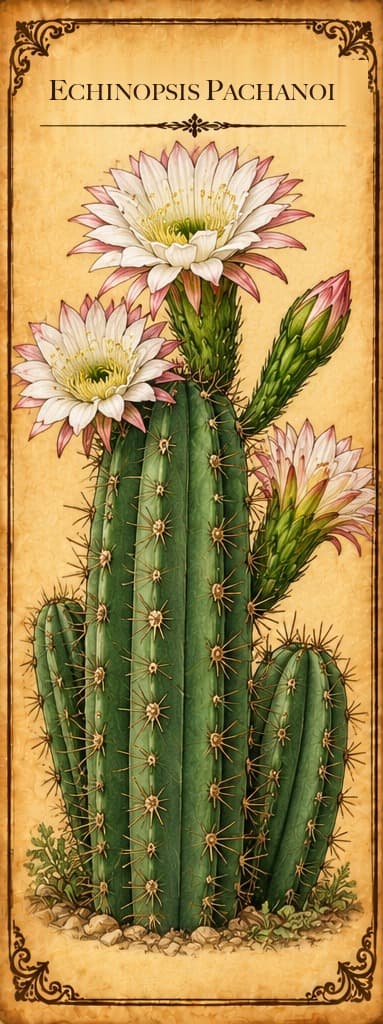
Echinopsis Pachanoi
Echinopsis pachanoi
The San Pedro cactus of the Andes, used in traditional medicine for centuries. It contains mescaline, a hallucinogen, whose effects and safety are poorly studied.
Safety at a glance
- PregnancyNothing recorded
- BreastfeedingNothing recorded
- MedicinesNothing recorded
- Who should avoid itNothing recorded
- AllergiesNothing recorded
- Toxicity1 note →
Tap a box to read the safety notes below. “Nothing recorded” means our sources don't cover it, not that it's safe.
What is Echinopsis Pachanoi?
- Plant family
- Cactaceae, the cactus family
- Parts used
- The stem
- Where it grows
- The Andes of Ecuador and Peru
- Genus
- Echinopsis
- Species
- pachanoi
Also called
San Pedro Cactus
Traditional names
Huachuma
Older scientific names
Trichocereus pachanoi
Traditionally used for
- Traditional ceremonies
Traditionally described as
- Hallucinogenic
Natural compounds
Safety
Toxicity testing
San Pedro contains mescaline, a hallucinogen. Commonly reported effects include high blood pressure, headache, nausea and vomiting. Its safety hasn't been properly studied.[1]Review or trial
What does the research say?
Traditional use
These are traditional uses, not proven treatments.
San Pedro is one of the two main mescaline-containing cacti, with peyote. Mescaline-containing cacti have been used in traditional medicine for centuries.[1]Review or trial
Research in people
A 2026 review found only 10 usable studies of people taking mescaline or mescaline-containing plants. Some reported improvements in depression, well-being, nicotine and alcohol use, and obsessions. The studies were few and of very mixed quality, so no firm conclusions can be drawn.[1]Review or trial
In short
Contains the hallucinogen mescaline; it can raise blood pressure and cause nausea and vomiting.
Sources
- [1] The Ethnopharmacological Use of Mescaline for Psychiatric Disorders: A Systematic Review · DOI: 10.3390/ijms27073081Review or clinical trial
This information is educational and traditional in nature, and is not a substitute for professional medical advice. Unfamiliar word? See what these words mean.