
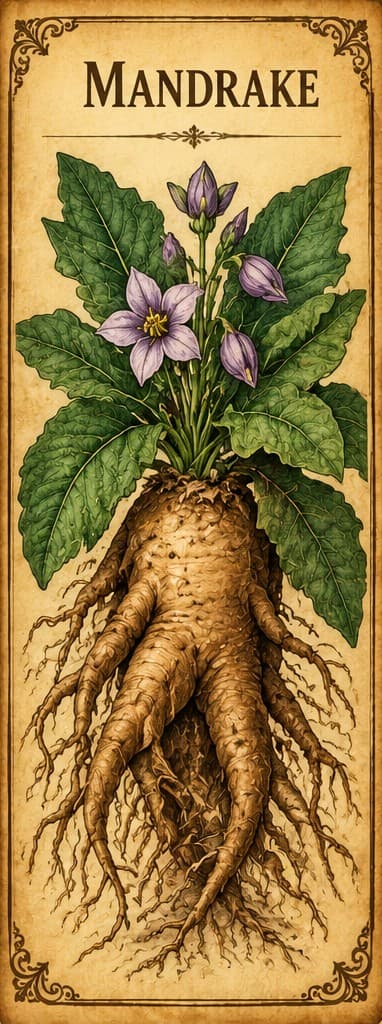
Mandrake
Mandragora autumnalis
A Mediterranean plant with a forked root, famous in myth and used in old herbal medicine for sleep, pain and fertility. Its root contains poisonous tropane alkaloids.
Safety at a glance
- PregnancyNothing recorded
- BreastfeedingNothing recorded
- MedicinesNothing recorded
- Who should avoid itNothing recorded
- AllergiesNothing recorded
- Toxicity1 note →
Tap a box to read the safety notes below. “Nothing recorded” means our sources don't cover it, not that it's safe.
What is Mandrake?
- Plant family
- Solanaceae, the nightshade family
- Parts used
- The root, leaves and berries
- Where it grows
- The Mediterranean region
- Genus
- Mandragora
- Species
- autumnalis
Also called
Autumn Mandrake
Traditionally used for
- Sleeplessness
- Inflammation
- Coughs
- Fertility
Traditionally described as
- Poisonous
- Hallucinogenic
Natural compounds
Safety
Side effects
Putting the root or its sap on the skin has caused redness, swelling, burning and scaly patches.[1]Study
Toxicity testing
Mandrake's alkaloids block a key nerve messenger (acetylcholine) throughout the body. This can change breathing and heart rate and cause muscle twitching and hallucinations.[1]Study
What does the research say?
Traditional use
These are traditional uses, not proven treatments.
Mandrake has long been used in herbal medicine around the Mediterranean and is famous in myth. It has been used as a hallucinogen, to boost fertility, and for ulcers, inflammation, sleeplessness and eye problems. In North Africa and Jordan, the leaves are taken for coughs, asthma and bronchitis.[1]Study
Laboratory & animal research
Lab and animal results show what might be worth studying in people. They don't show that the herb has these effects in humans.
The root is rich in tropane alkaloids such as scopolamine and hyoscyamine. In lab studies, extracts showed antioxidant activity, killed some bacteria, fungi and cancer cells, and blocked enzymes involved in blood sugar.[1]Study
In short
Its alkaloids can cause hallucinations and changes in breathing and heart rate.
Sources
- [1] Mandragora autumnalis Distribution, Phytochemical Characteristics, and Pharmacological Bioactivities · DOI: 10.3390/ph18030328Peer-reviewed study
This information is educational and traditional in nature, and is not a substitute for professional medical advice. Unfamiliar word? See what these words mean.