
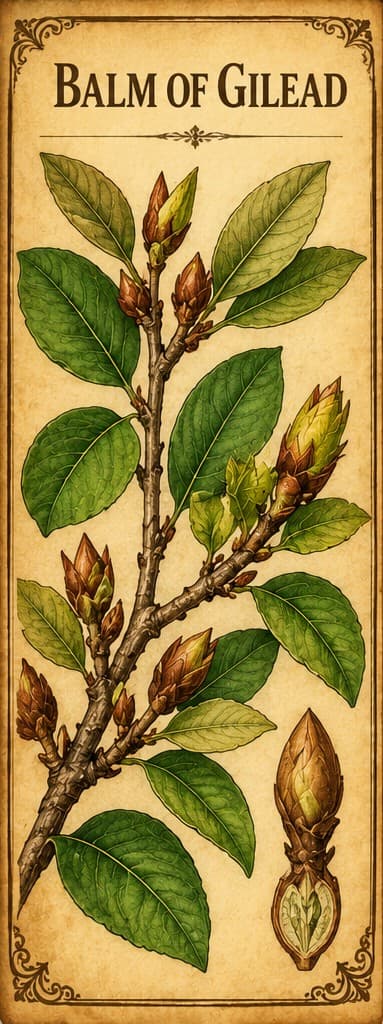
Balm of Gilead
Populus balsamifera
The sticky, fragrant buds of the balsam poplar, traditionally used for breathing problems and infections. In lab tests, the bud oil protected cells from a cold virus.
Safety at a glance
- PregnancyNothing recorded
- BreastfeedingNothing recorded
- MedicinesNothing recorded
- Who should avoid itNothing recorded
- AllergiesNothing recorded
- ToxicityNothing recorded
Tap a box to read the safety notes below. “Nothing recorded” means our sources don't cover it, not that it's safe.
What is Balm of Gilead?
- Plant family
- Salicaceae, the willow family
- Parts used
- The sticky, fragrant leaf buds
- Where it grows
- Northern North America
- Genus
- Populus
- Species
- balsamifera
Also called
Balsam Poplar, Poplar Buds
Traditionally used for
- Breathing problems
- Infections
Traditionally described as
- Antiviral (in lab studies)
- Antioxidant
Natural compounds
What does the research say?
Traditional use
These are traditional uses, not proven treatments.
Balsam poplar has traditionally been used for breathing problems and infections.[1]Study
Laboratory & animal research
Lab and animal results show what might be worth studying in people. They don't show that the herb has these effects in humans.
In lab tests, oil from the buds strongly protected cells from a common-cold coronavirus. Two of its main compounds, alpha-bisabolol and nerolidol, did the same.[1]Study
Technical detail: HCoV-OC43; EC50 3.3 µg/mL (oil), 2.7 µg/mL (α-bisabolol), 2.6 µg/mL (nerolidol).
Poplar leaf buds contain many phenolic compounds and showed antioxidant activity in lab tests.[2]Study
In short
No studies in people or safety studies were found.
Sources
- [1] Antiviral Activity of Essential Oil from Populus balsamifera L. Buds and Its Major Compounds Against Betacoronavirus HCoV-OC43 Using a Sensitive Cytoprotection Assay · DOI: 10.3390/molecules31091496Peer-reviewed study
- [2] Characterization of Secondary Metabolites of Leaf Buds from Some Species and Hybrids of Populus by Gas Chromatography Coupled with Mass Detection and Two-Dimensional High-Performance Thin-Layer Chromatography Methods with Assessment of Their Antioxidant Activity · DOI: 10.3390/ijms25073971Peer-reviewed study
This information is educational and traditional in nature, and is not a substitute for professional medical advice. Unfamiliar word? See what these words mean.