
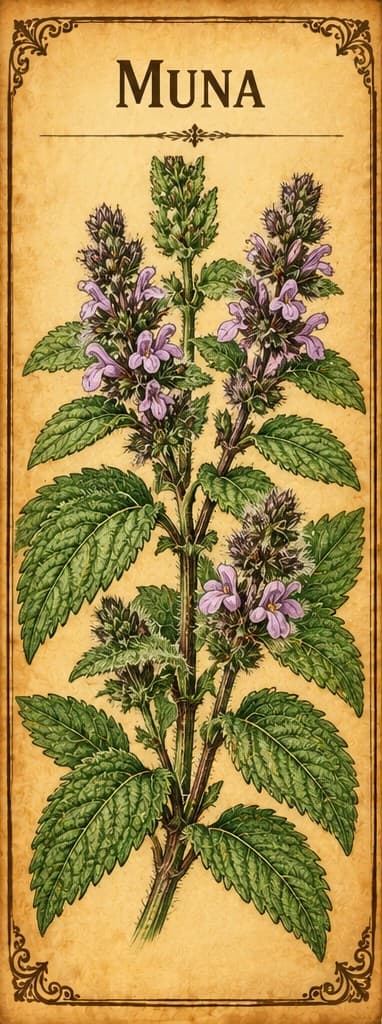
Muna
Minthostachys mollis
Muña, an aromatic Andean mint widely used in Peruvian traditional medicine. Farmers also layer its leaves in stored potatoes to keep moths away.
Safety at a glance
- PregnancyNothing recorded
- BreastfeedingNothing recorded
- MedicinesNothing recorded
- Who should avoid itNothing recorded
- AllergiesNothing recorded
- ToxicityNothing recorded
Tap a box to read the safety notes below. “Nothing recorded” means our sources don't cover it, not that it's safe.
What is Muna?
- Plant family
- Lamiaceae, the mint family
- Parts used
- The leaves
- Where it grows
- The Andes of Venezuela to Bolivia
- Genus
- Minthostachys
- Species
- mollis
Also called
Andean Mint
Regional names
Muña
Traditionally used for
- Traditional remedy
- Pest repellent
Traditionally described as
- Aromatic
- Repels insects
Natural compounds
What does the research say?
Traditional use
These are traditional uses, not proven treatments.
Laboratory & animal research
Lab and animal results show what might be worth studying in people. They don't show that the herb has these effects in humans.
The leaf oil is mostly pulegone (about 64%), with carvacrol and 1,8-cineole. In lab tests, it moderately blocked an enzyme that breaks down a memory-related brain messenger.[1]Study
Technical detail: acetylcholinesterase IC50 466.4 µg/mL.
In short
No studies in people or safety studies were found.
Sources
- [1] Chemical and enantioselective GC-MS characterization of Minthostachys mollis (Benth.) Griseb. Essential oil from Peru and its acetylcholinesterase inhibitory activity · DOI: 10.3389/fphar.2026.1864128Peer-reviewed study
- [2] Effectiveness of Repellent Plants for Controlling Potato Tuber Moth (Symmetrischema tangolias) in the Andean Highlands · DOI: 10.3390/insects17010024Peer-reviewed study
This information is educational and traditional in nature, and is not a substitute for professional medical advice. Unfamiliar word? See what these words mean.