
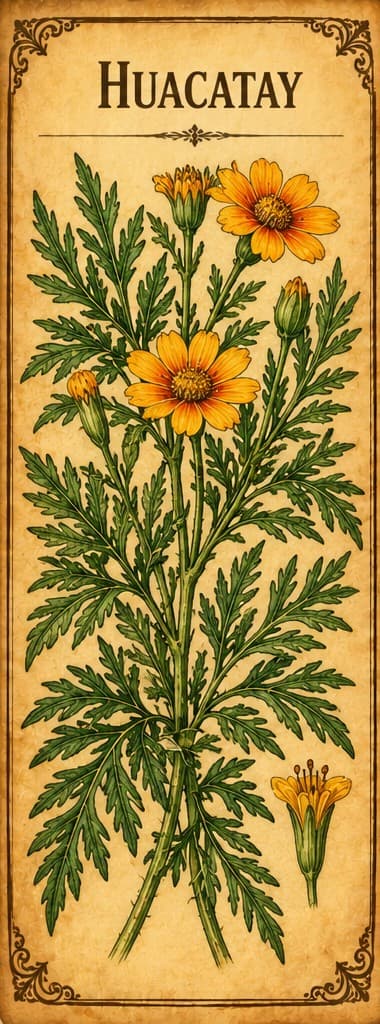
Huacatay
Tagetes minuta
A strong-smelling South American marigold, also called black mint. Its oil repels ticks and killed some bacteria in lab tests.
Safety at a glance
- PregnancyNothing recorded
- BreastfeedingNothing recorded
- MedicinesNothing recorded
- Who should avoid itNothing recorded
- AllergiesNothing recorded
- ToxicityNothing recorded
Tap a box to read the safety notes below. “Nothing recorded” means our sources don't cover it, not that it's safe.
What is Huacatay?
- Plant family
- Asteraceae, the daisy family
- Parts used
- The leaves and their essential oil
- Where it grows
- Southern South America; now a widespread weed
- Genus
- Tagetes
- Species
- minuta
Also called
Black Mint, Wild Marigold
Regional names
Khakibos
Traditionally used for
- Tick repellent
Traditionally described as
- Aromatic
- Repels ticks
- Antibacterial (in lab studies)
Natural compounds
What does the research say?
Traditional use
These are traditional uses, not proven treatments.
In South Africa, where it's called khakibos, communities use it to repel ticks from livestock. Lab tests confirm its oil strongly repels ticks.[1]Study
Laboratory & animal research
Lab and animal results show what might be worth studying in people. They don't show that the herb has these effects in humans.
In lab tests, the leaf oil killed E. coli and Staphylococcus aureus bacteria by damaging their outer membranes.[2]Study
Technical detail: main compounds (E)-tagetone, (Z)-ocimenone and β-pinene; E. coli MIC 17 mg/mL; S. aureus MIC 8.5 mg/mL.
In short
No studies in people or safety studies were found.
Sources
- [1] Plants Used for Tick and Tick-Borne Disease Control in South Africa: Ethnoveterinary Knowledge, Bioactivity Evidence, and Translation Pathways · DOI: 10.3390/plants14243720Peer-reviewed study
- [2] Antimicrobial Action of Essential Oil of Tagetes minuta: Role of the Bacterial Membrane in the Mechanism of Action · DOI: 10.3390/antibiotics14070632Peer-reviewed study
This information is educational and traditional in nature, and is not a substitute for professional medical advice. Unfamiliar word? See what these words mean.