
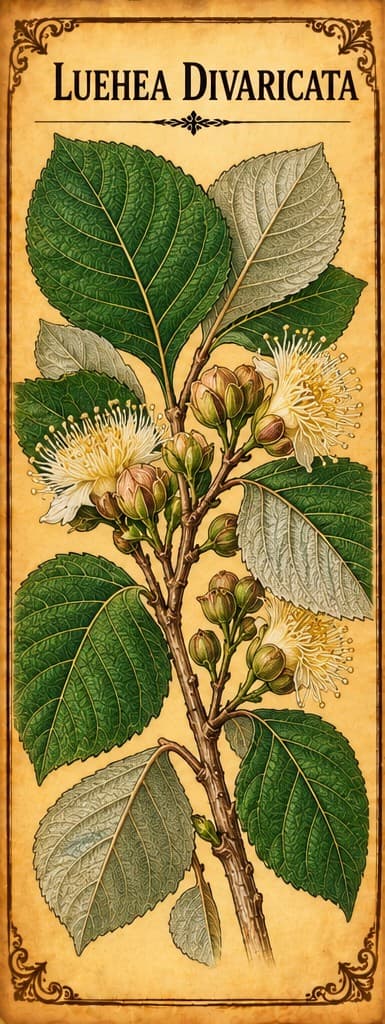
Luehea Divaricata
Luehea divaricata
A South American tree whose leaves Mbya-Guarani women use in a decoction meant to prevent pregnancy. No evidence supports that use, and the leaves contain potentially harmful compounds.
Safety at a glance
- PregnancyNothing recorded
- BreastfeedingNothing recorded
- MedicinesNothing recorded
- Who should avoid itNothing recorded
- AllergiesNothing recorded
- Toxicity1 note →
Tap a box to read the safety notes below. “Nothing recorded” means our sources don't cover it, not that it's safe.
What is Luehea Divaricata?
- Plant family
- Malvaceae, the mallow family
- Parts used
- The leaves
- Where it grows
- Southern Brazil, Paraguay, Uruguay and northeastern Argentina
- Genus
- Luehea
- Species
- divaricata
Regional names
Açoita-Cavalo
Traditional names
Ka'a Ovetĩ
Traditionally used for
- Contraception (traditional)
Traditionally described as
- Antiviral (in lab studies)
- Antioxidant
Natural compounds
Safety
Toxicity testing
The leaves contain compounds that could damage cells and genes. The researchers found no evidence that the contraceptive decoction works, and raised safety concerns about it.[1]Study
What does the research say?
Traditional use
These are traditional uses, not proven treatments.
Mbya-Guarani women use the leaves, with lapacho, in a decoction meant to prevent pregnancy.[1]Study
Laboratory & animal research
Lab and animal results show what might be worth studying in people. They don't show that the herb has these effects in humans.
A chemical study found nothing in the leaves that would explain a contraceptive effect. In lab tests, the extract slowed a plant-damaging mold.[1]Study
In lab tests, leaf extracts inactivated two cattle viruses and showed antioxidant activity. Their flavonoids, such as quercetin and kaempferol, were active too.[2]Study
In short
Its leaves contain compounds that may damage cells and genes.
Sources
- [1] Phytochemical study of 'tajy' (Handroanthus impetiginosus (Mart.) Mattos) and 'ka'a ovetĩ' (Luehea divaricata Mart.) extracts · DOI: 10.1080/14786419.2024.2319658Peer-reviewed study
- [2] Pampa biome plant extracts and flavonoids show antiviral activity against Bovine Herpesvirus and Bovine Viral Diarrhea Virus · DOI: 10.1038/s41598-026-50900-9Peer-reviewed study
This information is educational and traditional in nature, and is not a substitute for professional medical advice. Unfamiliar word? See what these words mean.