
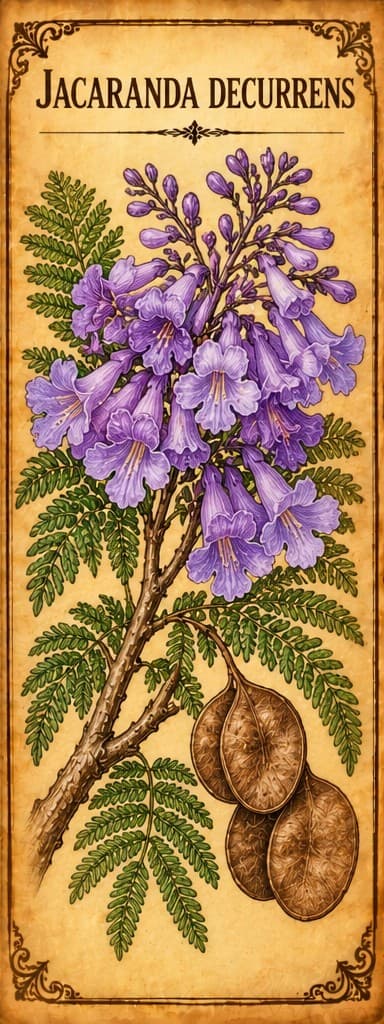
Jacaranda Decurrens
Jacaranda decurrens
Carobinha, a small jacaranda of Brazil's Cerrado savanna popularly used for skin diseases. In animal studies, its leaves sped wound healing and reduced weight gain.
Safety at a glance
- PregnancyNothing recorded
- BreastfeedingNothing recorded
- MedicinesNothing recorded
- Who should avoid itNothing recorded
- AllergiesNothing recorded
- ToxicityNothing recorded
Tap a box to read the safety notes below. “Nothing recorded” means our sources don't cover it, not that it's safe.
What is Jacaranda Decurrens?
- Plant family
- Bignoniaceae, the trumpet-creeper family
- Parts used
- The leaves
- Where it grows
- The Cerrado savanna of central Brazil
- Genus
- Jacaranda
- Species
- decurrens
Regional names
Carobinha
Traditionally used for
- Skin diseases
- Wounds
Traditionally described as
- Helps wounds heal (in animal studies)
Natural compounds
What does the research say?
Traditional use
These are traditional uses, not proven treatments.
Carobinha is common in Brazil's Cerrado savanna and is a popular remedy for skin diseases.[1]Study
Laboratory & animal research
Lab and animal results show what might be worth studying in people. They don't show that the herb has these effects in humans.
In mice, an ointment made from the leaves sped up wound healing, closing wounds within nine days with less inflammation and more new collagen.[1]Study
In obese rats, a leaf extract reduced body weight, body fat, cholesterol and triglycerides. Very high single doses caused no signs of poisoning in rats.[2]Study
Technical detail: acute doses 2 and 5 g/kg; hypercaloric diet model; contains jacaric and ursolic acids, luteolin, quercetin and kaempferol.
In short
No studies in people were found.
Sources
- [1] Chemical Characterization and Wound Healing Property of Jacaranda decurrens Cham. (Bignoniaceae): An Experimental Study Based on Molecular Mechanisms · DOI: 10.1155/2020/4749712Peer-reviewed study
- [2] Antiobesity Effects of Hydroethanolic Extract of Jacaranda decurrens Leaves · DOI: 10.1155/2016/4353604Peer-reviewed study
This information is educational and traditional in nature, and is not a substitute for professional medical advice. Unfamiliar word? See what these words mean.