
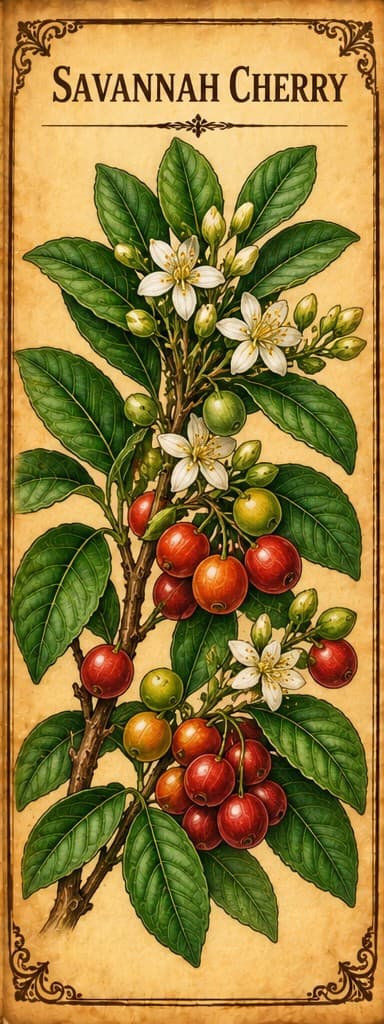
Savannah Cherry
Eugenia calycina
A threatened shrub of Brazil's Cerrado savanna with small red berries rich in antioxidant pigments. Its leaf oil killed mosquito larvae in lab tests.
Safety at a glance
- PregnancyNothing recorded
- BreastfeedingNothing recorded
- MedicinesNothing recorded
- Who should avoid itNothing recorded
- AllergiesNothing recorded
- ToxicityNothing recorded
Tap a box to read the safety notes below. “Nothing recorded” means our sources don't cover it, not that it's safe.
What is Savannah Cherry?
- Plant family
- Myrtaceae, the myrtle family
- Parts used
- The fruit and leaves
- Where it grows
- The Cerrado savanna of Brazil
- Genus
- Eugenia
- Species
- calycina
Also called
Cerrado Cherry
Traditionally used for
- Edible fruit
Traditionally described as
- Antioxidant
- Kills mosquito larvae (in lab studies)
Natural compounds
Safety
Contamination
Savannah cherry grows only in Brazil's Cerrado and is threatened with extinction.[1]Study
What does the research say?
Laboratory & animal research
Lab and animal results show what might be worth studying in people. They don't show that the herb has these effects in humans.
The red berries are low in calories and rich in anthocyanins (red plant pigments), rutin and ellagic acid, with strong antioxidant activity in lab tests.[2]Study
Technical detail: cyanidin-3-glucoside 242.97 µg/g; ORAC, FRAP and ABTS assays.
In lab tests, oil from the leaves killed the larvae of Aedes aegypti, the mosquito that spreads dengue, at doses lower than those that harmed mammal cells.[1]Study
Technical detail: LC50 166.4 µg/mL at 48 h; main compounds bicyclogermacrene, spathulenol and β-caryophyllene.
In short
It's threatened with extinction; no safety studies were found.
Sources
- [1] Essential oil from leaves of Eugenia calycina Cambes: Natural larvicidal against Aedes aegypti · DOI: 10.1002/jsfa.10732Peer-reviewed study
- [2] Eugenia calycina and Eugenia stigmatosa as Promising Sources of Antioxidant Phenolic Compounds · DOI: 10.3390/plants13152039Peer-reviewed study
This information is educational and traditional in nature, and is not a substitute for professional medical advice. Unfamiliar word? See what these words mean.