
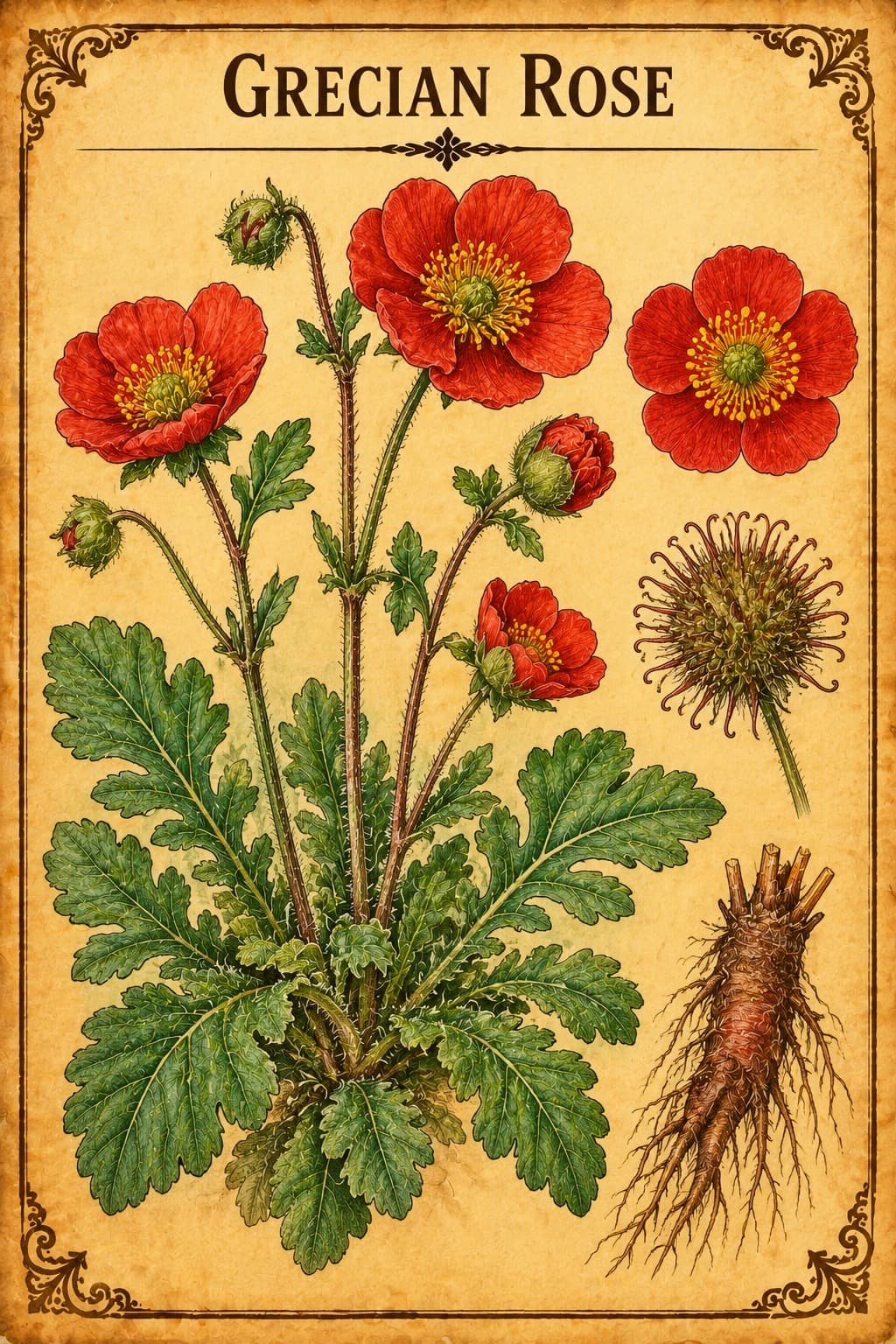
Grecian Rose
Geum quellyon
Chilean avens, or hierba del clavo, whose root is used in Mapuche medicine for tooth pain, stomach inflammation and prostatitis. It raised a transplant patient's cyclosporine to dangerous levels.
Safety at a glance
- PregnancyNothing recorded
- BreastfeedingNothing recorded
- Medicines1 note →
- Who should avoid itNothing recorded
- AllergiesNothing recorded
- ToxicityNothing recorded
Tap a box to read the safety notes below. “Nothing recorded” means our sources don't cover it, not that it's safe.
Grecian Rose may interact with some medicines. If you take any medicine, read Interactions with medicines below and talk to your doctor or pharmacist before using it.
What is Grecian Rose?
- Plant family
- Rosaceae, the rose family
- Parts used
- The roots
- Where it grows
- Central and southern Chile
- Genus
- Geum
- Species
- quellyon
Also called
Chilean Avens
Regional names
Hierba del Clavo
Older scientific names
Geum chiloense
Traditionally used for
- Tooth pain
- Stomach inflammation
- Prostatitis
- Menstruation
Traditionally described as
- Antioxidant (in lab studies)
Safety
Interactions with medicines
A kidney transplant patient who took hierba del clavo had dangerously high levels of the anti-rejection drug cyclosporine (ciclosporin). Levels returned to normal when he stopped the herb.[1]Study
What does the research say?
Traditional use
These are traditional uses, not proven treatments.
In the traditional medicine of the Mapuche people of Chile, the root is used:
- for tooth nerve pain
- for stomach inflammation and prostatitis
- to regulate menstruation
- to increase urination
- as an aphrodisiac
Laboratory & animal research
Lab and animal results show what might be worth studying in people. They don't show that the herb has these effects in humans.
In lab tests, a root extract rich in tannins showed strong antioxidant activity and killed colon, prostate and mouth cancer cells.[2]Study
Technical detail: Caco-2, DU-145 and KB cell lines; scavenged DPPH and superoxide; inhibited xanthine oxidase.
In short
It can dangerously raise levels of the anti-rejection drug cyclosporine.
Sources
- [1] Hierba del clavo (Geum chiloense) modifying cyclosporine levels: potential risk for transplanted people · DOI: 10.4067/s0034-98872001000700013Peer-reviewed study
- [2] Antioxidant activity and antiproliferative action of methanolic extract of Geum quellyon Sweet roots in human tumor cell lines · DOI: 10.1016/j.jep.2005.03.032Peer-reviewed study
This information is educational and traditional in nature, and is not a substitute for professional medical advice. Unfamiliar word? See what these words mean.