
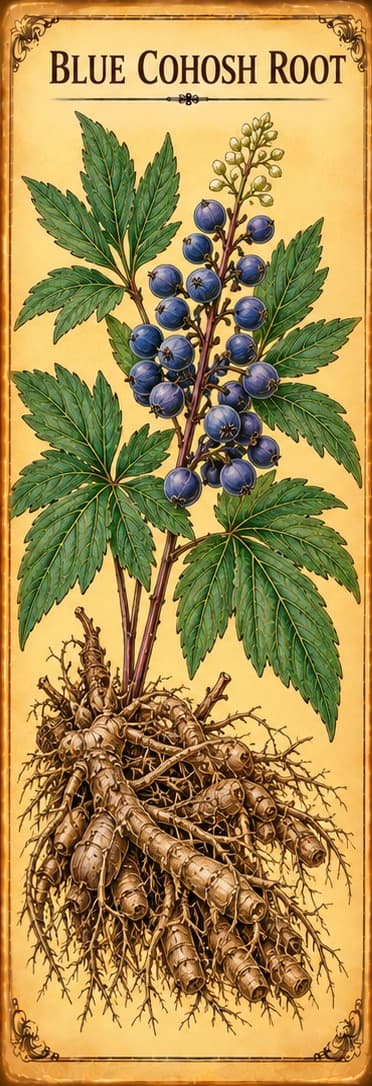
Blue Cohosh Root
Caulophyllum thalictroides
An eastern North American root used to bring on labor. It has caused severe heart, circulation and gut problems in mothers and newborns.
Safety at a glance
- Pregnancy1 note →
- Breastfeeding1 note →
- MedicinesNothing recorded
- Who should avoid itNothing recorded
- AllergiesNothing recorded
- ToxicityNothing recorded
Tap a box to read the safety notes below. “Nothing recorded” means our sources don't cover it, not that it's safe.
What is Blue Cohosh Root?
- Plant family
- Berberidaceae, the barberry family
- Parts used
- The root
- Where it grows
- Eastern North America
- Genus
- Caulophyllum
- Species
- thalictroides
Also called
Blue Cohosh, Papoose Root
Traditionally used for
- Bringing on labor
Traditionally described as
- Nicotine-like alkaloids
Natural compounds
Safety
Pregnancy
Blue cohosh can cause severe stomach, bowel, heart and circulation problems, including in newborns whose mothers used it to bring on labor. It's one of the herbal abortion remedies linked to serious illness and death.[1]Study
Breastfeeding
Most sources strongly advise against using it while breastfeeding, because of its possible toxicity and the lack of safety data.[2]Health agency
What does the research say?
Traditional use
These are traditional uses, not proven treatments.
Blue cohosh root has been used to bring on labor.[2]Health agency
Laboratory & animal research
Lab and animal results show what might be worth studying in people. They don't show that the herb has these effects in humans.
The root contains N-methylcytisine, which acts like nicotine, and caulosaponin, which narrows the heart's blood vessels and may make the womb contract.[2]Health agency
In short
Can cause severe heart and circulation problems, including in newborns.
Sources
- [1] Toxicities of herbal abortifacients · DOI: 10.1016/j.ajem.2023.03.005Peer-reviewed study
- [2] Blue Cohosh — Drugs and Lactation Database (LactMed) — U.S. National Library of Medicine, National Institutes of HealthGovernment health agency
This information is educational and traditional in nature, and is not a substitute for professional medical advice. Unfamiliar word? See what these words mean.