
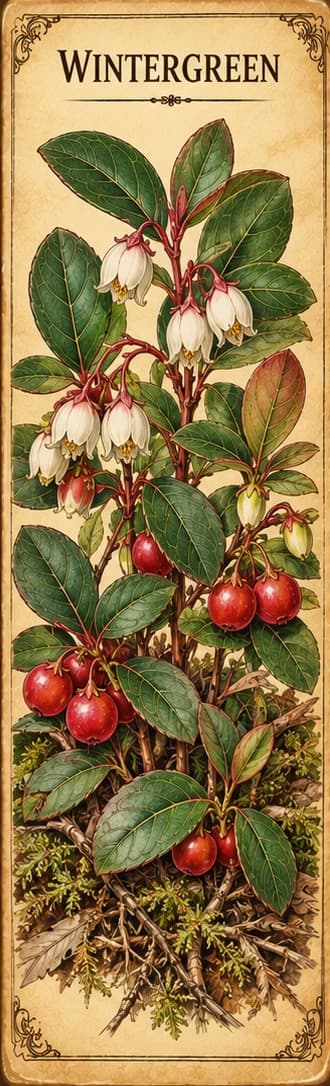
Wintergreen
Gaultheria procumbens
A low North American shrub whose aspirin-like oil has long been used for rheumatism, muscle pain, colds and fever. The oil is highly poisonous if swallowed.
Safety at a glance
- PregnancyNothing recorded
- BreastfeedingNothing recorded
- MedicinesNothing recorded
- Who should avoid itNothing recorded
- AllergiesNothing recorded
- Toxicity1 note →
Tap a box to read the safety notes below. “Nothing recorded” means our sources don't cover it, not that it's safe.
What is Wintergreen?
- Plant family
- Ericaceae, the heather family
- Parts used
- The leaves, berries and the essential oil distilled from them
- Where it grows
- Northeastern North America
- Genus
- Gaultheria
- Species
- procumbens
Also called
American Wintergreen, Eastern Teaberry
Traditionally used for
- Rheumatism
- Muscle pain
- Colds
- Fever
Traditionally described as
- Contains methyl salicylate
Natural compounds
Safety
Toxicity testing
Wintergreen oil is highly poisonous if swallowed. As little as 4 mL can kill a child and 6 mL an adult. Poisoning causes dizziness, vision and hearing problems, seizures, fluid in the lungs, kidney failure and coma. Large amounts on the skin can also poison you.[1]Study
What does the research say?
Traditional use
These are traditional uses, not proven treatments.
Wintergreen has been used for hundreds of years for inflammation and infections, especially rheumatoid arthritis, flu, colds and fever. Its oil is used for muscle pain.[1]Study
Laboratory & animal research
Lab and animal results show what might be worth studying in people. They don't show that the herb has these effects in humans.
Wintergreen oil is almost entirely methyl salicylate, an aspirin-like compound. The plant also contains more than 70 other compounds, including flavonoids. In lab tests, extracts may help reduce inflammation and showed antioxidant activity, but there are no clinical trials.[1]Study
In short
A few milliliters of the oil can kill a child.
Sources
- [1] Phytochemistry and Biological Profile of Gaultheria procumbens L. and Wintergreen Essential Oil: From Traditional Application to Molecular Mechanisms and Therapeutic Targets · DOI: 10.3390/ijms25010565Peer-reviewed study
This information is educational and traditional in nature, and is not a substitute for professional medical advice. Unfamiliar word? See what these words mean.