
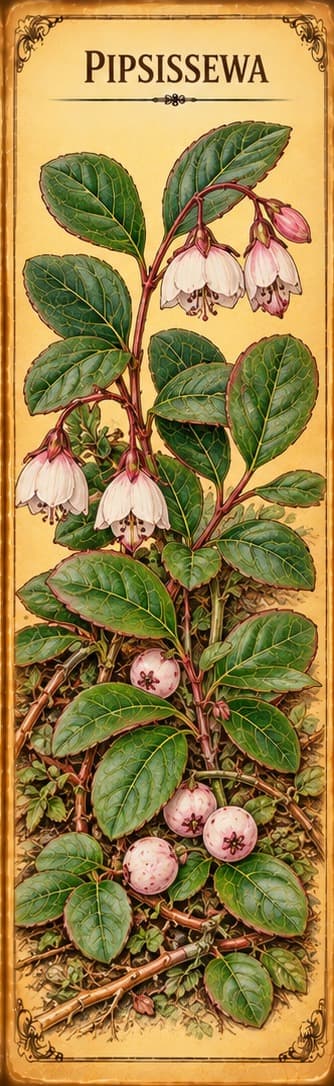
Pipsissewa
Chimaphila umbellata
A small evergreen woodland plant whose leaves are used in Appalachia for rheumatism. Its compound chimaphilin has been studied in the lab.
Safety at a glance
- PregnancyNothing recorded
- BreastfeedingNothing recorded
- MedicinesNothing recorded
- Who should avoid itNothing recorded
- AllergiesNothing recorded
- ToxicityNothing recorded
Tap a box to read the safety notes below. “Nothing recorded” means our sources don't cover it, not that it's safe.
What is Pipsissewa?
- Plant family
- Ericaceae, the heather family
- Parts used
- The leaves
- Where it grows
- Temperate forests of North America, Europe and Asia
- Genus
- Chimaphila
- Species
- umbellata
Also called
Prince's Pine
Traditionally used for
- Rheumatism
- Joint inflammation
Traditionally described as
- Antifungal (in lab studies)
- Antioxidant
Natural compounds
What does the research say?
Traditional use
These are traditional uses, not proven treatments.
In eastern Kentucky, the leaves are used for rheumatism. As early as 1844, pipsissewa was used for inflamed joint linings and damaged cartilage.[1]Study
Laboratory & animal research
Lab and animal results show what might be worth studying in people. They don't show that the herb has these effects in humans.
Its main compound, chimaphilin, killed fungi and made breast cancer cells self-destruct in lab tests. The plant also showed antioxidant activity.[1]Study
In short
No studies in people or safety studies were found.
Sources
- [1] A Review and Survey of Local Eastern Kentucky Medicinal Plants and Their Pharmacological Benefits · DOI: 10.3390/plants14203182Peer-reviewed study
This information is educational and traditional in nature, and is not a substitute for professional medical advice. Unfamiliar word? See what these words mean.