
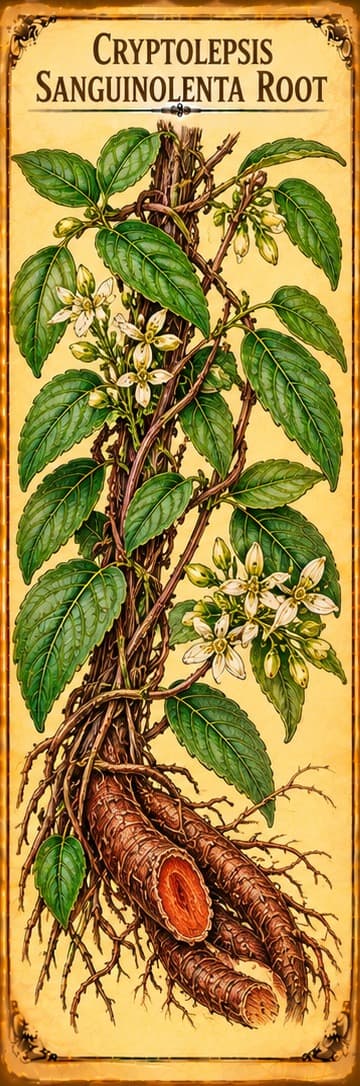
Cryptolepis Sanguinolenta Root
Cryptolepis sanguinolenta
A West African vine whose root is used in Ghana, often with neem, in herbal malaria medicines. In lab tests it strongly killed malaria parasites, including drug-resistant ones.
Safety at a glance
- PregnancyNothing recorded
- BreastfeedingNothing recorded
- MedicinesNothing recorded
- Who should avoid itNothing recorded
- AllergiesNothing recorded
- ToxicityNothing recorded
Tap a box to read the safety notes below. “Nothing recorded” means our sources don't cover it, not that it's safe.
What is Cryptolepis Sanguinolenta Root?
- Plant family
- Apocynaceae, the dogbane and milkweed family
- Parts used
- The root
- Where it grows
- West and Central Africa
- Genus
- Cryptolepis
- Species
- sanguinolenta
Traditionally used for
- Malaria
Traditionally described as
- Kills malaria parasites (in lab studies)
Traditions that use it
- African Traditional Medicine
Used in Ghana, often with neem, in herbal malaria medicines.
Natural compounds
Safety
Contamination
Most herbal malaria medicines tested in Ghana worked poorly against the parasite.[1]Study
What does the research say?
Traditional use
These are traditional uses, not proven treatments.
In Ghana, cryptolepis root is commonly combined with neem in herbal malaria medicines.[2]Study
Laboratory & animal research
Lab and animal results show what might be worth studying in people. They don't show that the herb has these effects in humans.
In lab tests, water extracts of cryptolepis and neem strongly killed malaria parasites, including a strain resistant to chloroquine. Together they worked better than either alone.[2]Study
Technical detail: IC50 ≤ 10 µg/mL against P. falciparum 3D7 and DD2; combination index 0.15–0.61.
When 20 herbal malaria medicines sold in Accra were tested in the lab, only 6 strongly killed malaria parasites. The authors call for better testing and quality control of these products.[1]Study
In lab tests, extracts of the root slowed the bacteria that cause tuberculosis.[3]Study
In short
Most Ghanaian herbal malaria products tested worked poorly against the parasite.
Sources
- [1] The efficacy of selected Ghanaian herbal antimalarials against laboratory strains and clinical isolates of Plasmodium falciparum · DOI: 10.1038/s41598-025-19429-1Peer-reviewed study
- [2] Synergistic Combination of Cryptolepis sanguinolenta (Lindl.) Schlechter (Apocynaceae) and Azadirachta Indica (A. Juss) (Meliaceae) Against 3D7 and DD2 Strains of Plasmodium Falciparum · DOI: 10.1155/adpp/1273876Peer-reviewed study
- [3] Antimycobacterial Activities of Cryptolepis sanguinolenta, Lantana camara, Zanthoxylum leprieurii Modeled as a Function of Their Fingerprints for Active Compounds Identification · DOI: 10.1055/a-2660-2042Peer-reviewed study
This information is educational and traditional in nature, and is not a substitute for professional medical advice. Unfamiliar word? See what these words mean.