
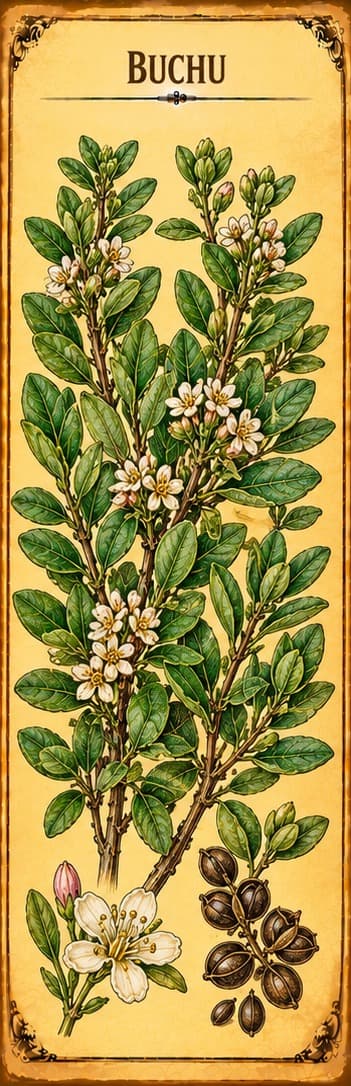
Buchu
Agathosma betulina
A fragrant South African shrub long used by the Khoisan, and later in Europe and the US, for urinary infections and other ailments. It has only been studied in the lab and in animals.
Safety at a glance
- PregnancyNothing recorded
- BreastfeedingNothing recorded
- MedicinesNothing recorded
- Who should avoid itNothing recorded
- AllergiesNothing recorded
- Toxicity1 note →
Tap a box to read the safety notes below. “Nothing recorded” means our sources don't cover it, not that it's safe.
What is Buchu?
- Plant family
- Rutaceae, the citrus family
- Parts used
- The leaves and their essential oil
- Where it grows
- The mountains of the Western Cape, South Africa
- Genus
- Agathosma
- Species
- betulina
Also called
Round-Leaf Buchu
Traditionally used for
- Urinary infections
- Colds
- Stomach problems
- Rheumatism
- Gout (traditional)
Traditionally described as
- Aromatic; the oil contains pulegone
Traditions that use it
- African Traditional Medicine
A long-standing South African household remedy.
Safety
Toxicity testing
High doses of buchu essential oil damaged the liver and affected the uterus in rats. This is linked to pulegone, a compound in the oil that is toxic to the liver.[1]Study
What does the research say?
Traditional use
These are traditional uses, not proven treatments.
Buchu has long been a household remedy in South Africa for various ailments. Its essential oil is also used in cosmetics and medicines.[2]Study
The Khoisan peoples of South Africa used buchu long before written records: in rituals, for anointing and perfume, and as medicine. Traditional uses include kidney and urinary infections, colds, stomach problems, rheumatism, gout and fever.[1]Study
In the 1800s buchu became a popular remedy for urinary infections in Europe and the US, and was listed in the Dublin pharmacopoeia in 1826 as a medicine to increase urine flow. It fell out of use once antibiotics arrived, but is still sold in herbal products for urinary problems.[1]Study
Buchu oil, made from Agathosma betulina, is one of South Africa's best-known plant products, sold around the world.[3]Study
The Khoi-San used the word "buchu" for any fragrant plant that could be dried and powdered. Today it means two species, round-leaf buchu (Agathosma betulina) and oval-leaf buchu (Agathosma crenulata).[3]Study
Indigenous people introduced buchu to European settlers at the Cape in the 1650s, and its use spread to Europe and America. It's still used across South Africa as a general tonic and medicine. Traditional uses include easing cramps, bringing down fever, as a rub, and for coughs.[3]Study
Laboratory & animal research
Lab and animal results show what might be worth studying in people. They don't show that the herb has these effects in humans.
Buchu leaves contain phenolic acids, flavonoids, saponins and terpenoids. The amounts differ a lot depending on where the plant grows.[2]Study
Research is scarce. In lab tests, a leaf extract had moderate activity against microbes (the essential oil didn't), and extracts reduced inflammation signals and helped cells take up sugar. In rats, a water extract brought high blood sugar down to normal, and in rats on a high-fat diet it reduced weight gain and lowered high blood pressure. The extracts' makeup often wasn't stated, and no proper human trials have been done.[1]Study
A 2008 review reported that buchu extracts and essential oils were active against four disease-causing bacteria in lab tests, including Staphylococcus aureus. It noted that most buchu research has been in the lab, and few studies have tested its traditional uses.[3]Study
In short
High doses of the essential oil damaged the liver in rats.
Sources
- [1] Buchu (Agathosma betulina and A. crenulata): Rightfully Forgotten or Underutilized? · DOI: 10.3389/fphar.2022.813142Peer-reviewed study
- [2] Geographic Influence on Secondary Metabolite Profiles in Leaves of the Endemic Agathosma betulina (P.J. Bergius) Pillans. in the Western Cape Province, South Africa · DOI: 10.3390/ijms27104486Peer-reviewed study
- [3] 'Buchu' – Agathosma betulina and Agathosma crenulata (Rutaceae): A review · DOI: 10.1016/j.jep.2008.07.036Peer-reviewed study
This information is educational and traditional in nature, and is not a substitute for professional medical advice. Unfamiliar word? See what these words mean.