
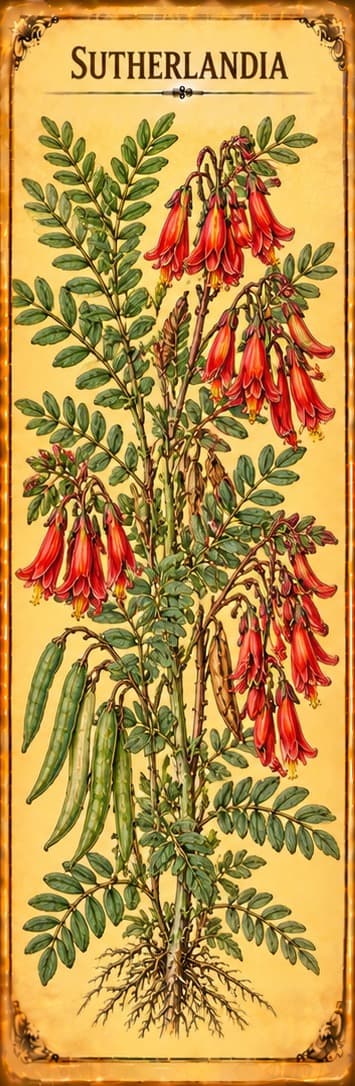
Sutherlandia
Lessertia frutescens
"Cancer bush", one of South Africa's most popular medicinal plants. A critical review found its cancer research unconvincing and doesn't recommend it for cancer.
Safety at a glance
- PregnancyNothing recorded
- BreastfeedingNothing recorded
- Medicines1 note →
- Who should avoid itNothing recorded
- AllergiesNothing recorded
- ToxicityNothing recorded
Tap a box to read the safety notes below. “Nothing recorded” means our sources don't cover it, not that it's safe.
Sutherlandia may interact with some medicines. If you take any medicine, read Interactions with medicines below and talk to your doctor or pharmacist before using it.
What is Sutherlandia?
- Plant family
- Fabaceae, the pea and bean family
- Parts used
- The leaves and shoots
- Where it grows
- The drier regions of southern Africa
- Genus
- Lessertia
- Species
- frutescens
Also called
Cancer Bush
Older scientific names
Sutherlandia frutescens
Traditionally used for
- Cancer (traditional)
- General health
Traditionally described as
- Affects the immune system (in lab studies)
Traditions that use it
- African Traditional Medicine
One of South Africa's most popular medicinal plants.
Safety
Interactions with medicines
The reviewers say Sutherlandia shouldn't currently be recommended for cancer, partly because of possible interactions with other medicines.[1]Study
What does the research say?
Traditional use
These are traditional uses, not proven treatments.
Sutherlandia, or cancer bush, is one of South Africa's most widely used medicinal plants. It's used by Indigenous communities and, as its name suggests, to prevent and treat cancer.[2]Study
Laboratory & animal research
Lab and animal results show what might be worth studying in people. They don't show that the herb has these effects in humans.
In lab and animal studies, it has shown effects on cancer cells, the immune system, inflammation, blood sugar, stress and microbes.[2]Study
A 2025 critical review found that many cancer studies of Sutherlandia used far too-high doses or lacked proper controls, making them look overly hopeful. It concluded that the plant doesn't show acceptable anticancer activity, and there are no rigorous animal studies or clinical trials.[1]Study
In short
Not recommended for cancer; possible interactions with other medicines.
Sources
- [1] The "Cancer Bush" Sutherlandia (syn. Lessertia) frutescens. An Example of Promotional Research, or Is There Scientific Merit? · DOI: 10.1055/a-2654-6280Peer-reviewed study
- [2] Phytochemistry, Ethnopharmacology, and Pharmacology of Lessertia frutescens (Cancer Bush): A Comprehensive Review · DOI: 10.3390/plants14142086Peer-reviewed study
This information is educational and traditional in nature, and is not a substitute for professional medical advice. Unfamiliar word? See what these words mean.