
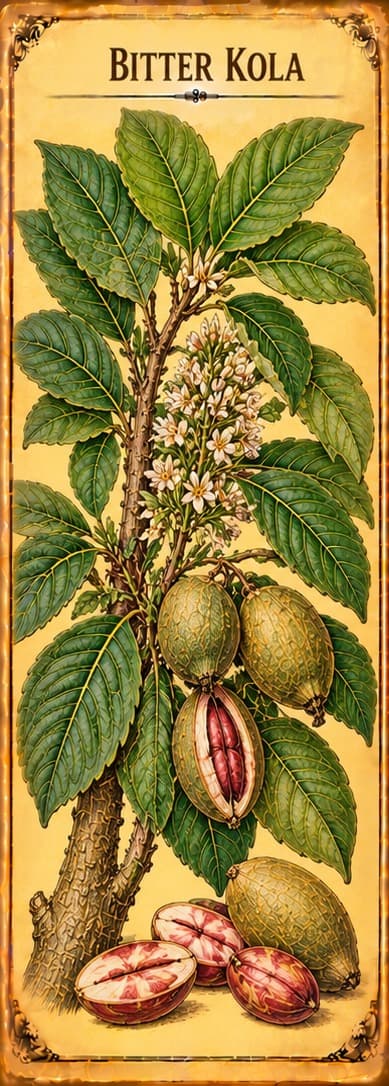
Bitter Kola
Garcinia kola
A West African nut chewed in social ceremonies and as a folk remedy for breathing problems, stomach upsets and malaria.
Safety at a glance
- PregnancyNothing recorded
- BreastfeedingNothing recorded
- MedicinesNothing recorded
- Who should avoid itNothing recorded
- AllergiesNothing recorded
- ToxicityNothing recorded
Tap a box to read the safety notes below. “Nothing recorded” means our sources don't cover it, not that it's safe.
What is Bitter Kola?
- Plant family
- Clusiaceae, the mangosteen family
- Parts used
- The seeds (nuts), usually chewed fresh
- Where it grows
- West and Central Africa
- Genus
- Garcinia
- Species
- kola
Older scientific names
Garcinia kola
Traditionally used for
- Breathing problems
- Stomach upset
- Malaria
- General well-being
Traditionally described as
- Antioxidant
Traditions that use it
- African Traditional Medicine
Chewed in social ceremonies and for many ailments.
What does the research say?
Traditional use
These are traditional uses, not proven treatments.
Bitter kola nuts are chewed in West and Central African social ceremonies and used for malaria, breathing infections, stomach upsets, hepatitis, and metabolic and sexual problems. In a survey of 152 Nigerians, mostly Ibibio, Annang and Igbo, most chewed the fresh seeds for breathing symptoms, stomach upset and general well-being.[1]Study
Laboratory & animal research
Lab and animal results show what might be worth studying in people. They don't show that the herb has these effects in humans.
Research supports some of these uses, including antioxidant, immune, stomach, liver, blood sugar, breathing, reproductive and pain-relieving effects, and possible antimicrobial and liver-protecting activity. Standard doses and safety for each part of the plant still need to be worked out.[1]Study
Research in people
In a 6-week trial in Nigeria, 84 people with knee arthritis took bitter kola (200 mg twice a day), a placebo, or the painkillers naproxen or celecoxib. Bitter kola reduced pain and stiffness and improved walking compared with the placebo. It worked about as well as the painkillers for pain, but started working more slowly and its effect didn't last as long.[2]Study
Technical detail: randomized, placebo-controlled, double-blind; WOMAC pain VAS, p < 0.001 vs placebo.
In short
Standard doses and safety haven't been established.
Sources
- [1] Traditional use of Garcinia kola Heckel in Nigeria - the results of questionnaire survey compared with scientific evidence · DOI: 10.1186/s12906-026-05287-5Peer-reviewed study
- [2] Clinical effects of Garcinia kola in knee osteoarthritis · DOI: 10.1186/1749-799X-3-34Peer-reviewed study
This information is educational and traditional in nature, and is not a substitute for professional medical advice. Unfamiliar word? See what these words mean.