
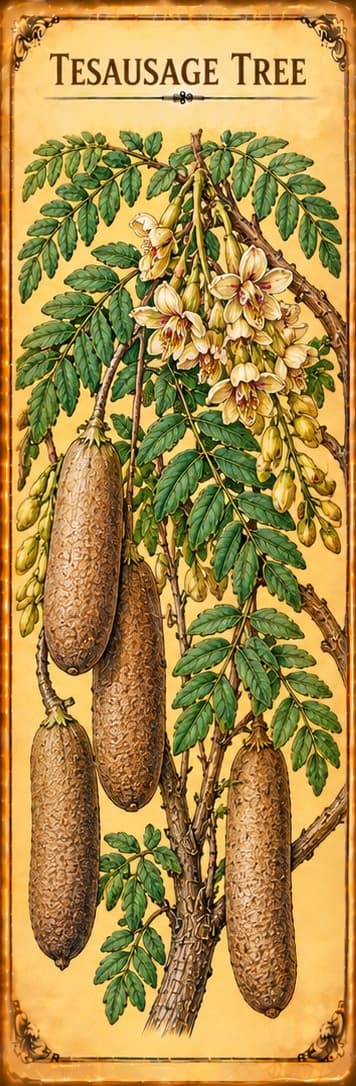
Sausage Tree
Kigelia africana
An African tree with huge sausage-shaped fruit, an established plant in African traditional medicine. Its fruit extract slowed colon cancer cells in the lab.
Safety at a glance
- PregnancyNothing recorded
- BreastfeedingNothing recorded
- MedicinesNothing recorded
- Who should avoid itNothing recorded
- AllergiesNothing recorded
- ToxicityNothing recorded
Tap a box to read the safety notes below. “Nothing recorded” means our sources don't cover it, not that it's safe.
What is Sausage Tree?
- Plant family
- Bignoniaceae, the trumpet-creeper family
- Parts used
- The large sausage-shaped fruit
- Where it grows
- Tropical and southern Africa
- Genus
- Kigelia
- Species
- africana
Also called
Kigelia
Traditionally used for
- Traditional medicine
Traditionally described as
- Slows cancer cells (in lab studies)
Traditions that use it
- African Traditional Medicine
An established medicinal plant in African traditional medicine.
What does the research say?
Traditional use
These are traditional uses, not proven treatments.
The sausage tree is an established medicinal plant in African traditional medicine.[1]Study
Laboratory & animal research
Lab and animal results show what might be worth studying in people. They don't show that the herb has these effects in humans.
In lab tests on colon cancer cells, a fruit extract moderately slowed the cells and changed proteins linked to cancer spread. Combined with the chemotherapy drug cisplatin, it killed more cancer cells, allowing a lower cisplatin dose.[1]Study
Technical detail: HT-29 cells; 14 metabolites identified, including phenolic acids, naphthoquinones and iridoids.
In short
No studies in people or safety studies were found.
Sources
- [1] Integrative Evaluation of Kigelia africana Fruit Extract: Broad-Spectrum Anticancer Activity, Synergism with Cisplatin and Mechanistic Insights in Colorectal Carcinoma · DOI: 10.3390/molecules31010107Peer-reviewed study
This information is educational and traditional in nature, and is not a substitute for professional medical advice. Unfamiliar word? See what these words mean.