
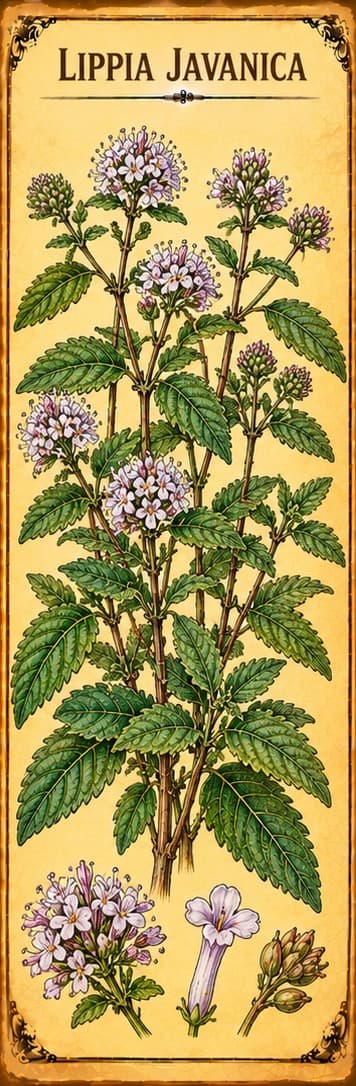
Lippia Javanica
Lippia javanica
Fever tea, a fragrant African shrub used in South Africa to keep ticks off livestock. In rats, its tea protected the brain from lead damage.
Safety at a glance
- PregnancyNothing recorded
- BreastfeedingNothing recorded
- MedicinesNothing recorded
- Who should avoid itNothing recorded
- AllergiesNothing recorded
- ToxicityNothing recorded
Tap a box to read the safety notes below. “Nothing recorded” means our sources don't cover it, not that it's safe.
What is Lippia Javanica?
- Plant family
- Verbenaceae, the verbena family
- Parts used
- The leaves, usually as a tea
- Where it grows
- Southern and eastern Africa
- Genus
- Lippia
- Species
- javanica
Also called
Fever Tea, Lemon Bush
Traditionally used for
- Tick repellent
- Herbal tea
Traditionally described as
- Repels ticks
- Antioxidant (in animal studies)
Traditions that use it
- African Traditional Medicine
Used in South Africa to repel ticks from livestock.
What does the research say?
Traditional use
These are traditional uses, not proven treatments.
Communities in South Africa use Lippia javanica to repel or kill ticks on livestock. In a community-led field trial, a leaf spray substantially reduced ticks, though slightly less than the chemical amitraz.[1]Study
Lemon bush grows in central, eastern and southern Africa and in India. It's drunk as an everyday and medicinal tea, and used for colds, coughs, fever, malaria, wounds, diarrhea, chest pain, bronchitis and asthma.[2]Study
Laboratory & animal research
Lab and animal results show what might be worth studying in people. They don't show that the herb has these effects in humans.
In rats given lead, drinking Lippia javanica tea for 6 weeks protected the brain from damage: it raised antioxidant levels and reduced inflammation and cell death. The tea alone caused no harm.[3]Study
Technical detail: 5 mL/kg infusion; increased glutathione and superoxide dismutase; reduced TNF-α, Bax and acetylcholinesterase activity.
In lab studies it was active against microbes and the malaria parasite, and acted as an antioxidant. The review calls for studies of its safety and clinical value.[2]Study
In short
No studies in people or safety studies were found.
Sources
- [1] Plants Used for Tick and Tick-Borne Disease Control in South Africa: Ethnoveterinary Knowledge, Bioactivity Evidence, and Translation Pathways · DOI: 10.3390/plants14243720Peer-reviewed study
- [2] Lippia javanica (Burm.f.) Spreng.: Traditional and Commercial Uses and Phytochemical and Pharmacological Significance in the African and Indian Subcontinent · DOI: 10.1155/2017/6746071Peer-reviewed study
- [3] Neuroprotective effects of Lippia javanica (Burm.F.) Spreng. Herbal tea infusion on Lead-induced oxidative brain damage in Wistar rats · DOI: 10.1186/s12906-021-03471-3Peer-reviewed study
This information is educational and traditional in nature, and is not a substitute for professional medical advice. Unfamiliar word? See what these words mean.