
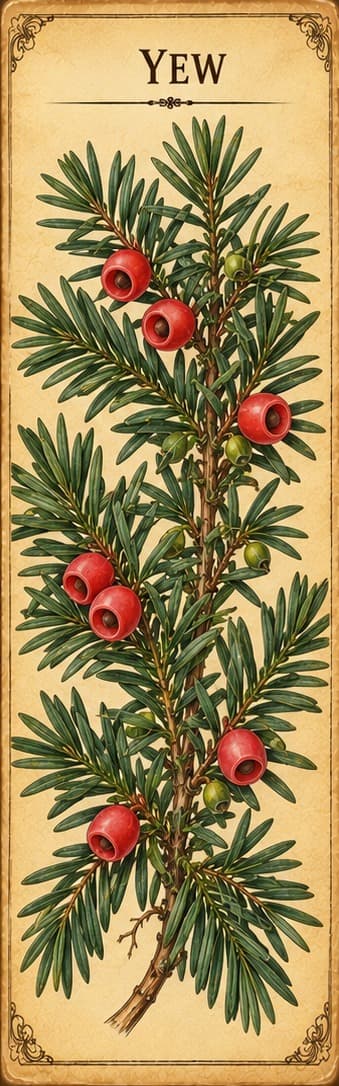
Yew
Taxus baccata
An evergreen tree whose leaves and seeds contain taxine alkaloids, deadly poisons that stop the heart. It isn't used as a remedy.
Safety at a glance
- PregnancyNothing recorded
- BreastfeedingNothing recorded
- MedicinesNothing recorded
- Who should avoid itNothing recorded
- AllergiesNothing recorded
- Toxicity2 notes →
Tap a box to read the safety notes below. “Nothing recorded” means our sources don't cover it, not that it's safe.
What is Yew?
- Plant family
- Taxaceae, the yew family
- Parts used
- None; the leaves and seeds are poisonous
- Where it grows
- Europe, North Africa and western Asia
- Genus
- Taxus
- Species
- baccata
Also called
Common Yew, English Yew
Traditionally used for
- None (poisonous)
Traditionally described as
- Poisonous
Natural compounds
Safety
Toxicity testing
Yew is deadly poisonous. A 16-year-old who ate yew leaves developed life-threatening irregular heart rhythms. A 39-year-old man survived yew poisoning only after long, intensive resuscitation.[1]Study
Eating yew leaves can cause dangerous fast heart rhythms (ventricular tachycardia and fibrillation).[2]Study
What does the research say?
Laboratory & animal research
Lab and animal results show what might be worth studying in people. They don't show that the herb has these effects in humans.
Yew contains taxine alkaloids, which cause fatal poisoning mainly by damaging the heart and circulation.[1]Study
In short
Eating yew can cause fatal heart rhythm problems.
Sources
- [1] Common yew intoxication: a case report · DOI: 10.1186/1752-1947-8-4Peer-reviewed study
- [2] Cardiovascular toxicity associated with yew leaf ingestion · DOI: 10.1136/hrt.72.1.92Peer-reviewed study
This information is educational and traditional in nature, and is not a substitute for professional medical advice. Unfamiliar word? See what these words mean.