
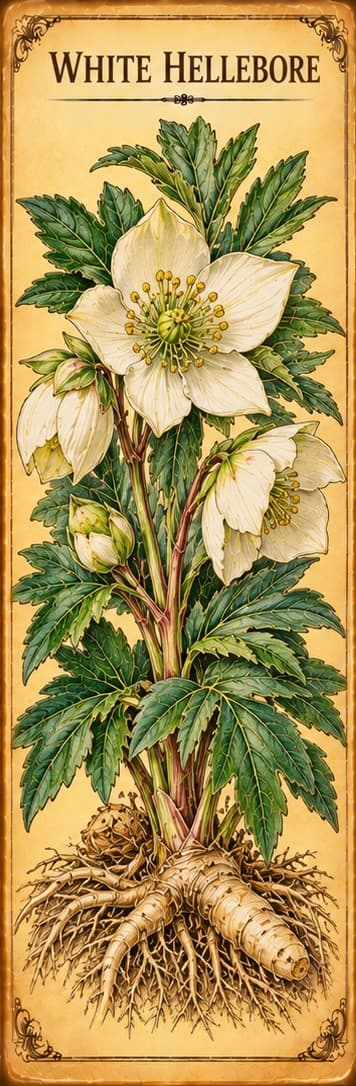
White Hellebore
Veratrum album
A poisonous mountain plant of Europe and northern Asia. In Bulgaria, a decoction of it has been made for hair loss.
Safety at a glance
- PregnancyNothing recorded
- BreastfeedingNothing recorded
- MedicinesNothing recorded
- Who should avoid itNothing recorded
- AllergiesNothing recorded
- Toxicity2 notes →
Tap a box to read the safety notes below. “Nothing recorded” means our sources don't cover it, not that it's safe.
What is White Hellebore?
- Plant family
- Melanthiaceae, the false hellebore family
- Parts used
- The root (poisonous)
- Where it grows
- The mountains of Europe and northern Asia
- Genus
- Veratrum
- Species
- album
Also called
False Helleborine, European White Hellebore
Traditionally used for
- Hair loss (folk use)
Traditionally described as
- Contains Veratrum steroidal alkaloids
Natural compounds
Safety
Toxicity testing
White hellebore is poisonous. Four people in Bulgaria who drank a hair-loss decoction by mistake developed dizziness, nausea, vomiting, low blood pressure, a very slow heartbeat and serious heart rhythm problems. Its toxins act on the heart's sodium channels; with hospital treatment, deaths are rare.[1]Study
Veratrum alkaloids cause vomiting followed by slow breathing, low blood pressure and a slow heartbeat. Most reported poisonings involve white hellebore. Some of these alkaloids also cause severe birth defects.[2]Study
What does the research say?
Traditional use
These are traditional uses, not proven treatments.
In Bulgaria, a white hellebore decoction has been prepared to treat hair loss.[1]Study
In short
Poisonous. Causes vomiting, low blood pressure, a very slow heartbeat and heart rhythm problems.
Sources
- [1] A 20-Year Retrospective Analysis of Plant Poisoning Cases at the Naval Hospital, Varna, Bulgaria · DOI: 10.3390/toxins17040197Peer-reviewed study
- [2] Hikers poisoned: Veratrum steroidal alkaloid toxicity following ingestion of foraged Veratrum parviflorum · DOI: 10.1080/15563650.2018.1442007Peer-reviewed study
This information is educational and traditional in nature, and is not a substitute for professional medical advice. Unfamiliar word? See what these words mean.