
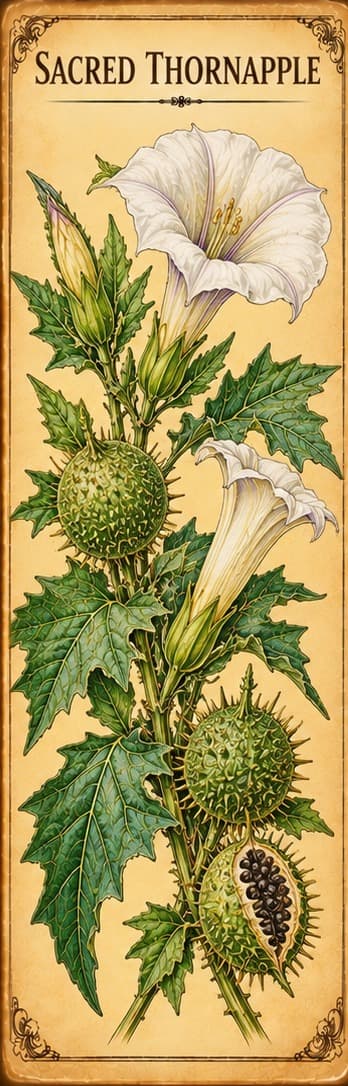
Sacred Thornapple
Datura wrightii
A datura of the American Southwest. Its withanolides have been studied against cancer cells in the lab.
Safety at a glance
- PregnancyNothing recorded
- BreastfeedingNothing recorded
- MedicinesNothing recorded
- Who should avoid itNothing recorded
- AllergiesNothing recorded
- Toxicity1 note →
Tap a box to read the safety notes below. “Nothing recorded” means our sources don't cover it, not that it's safe.
What is Sacred Thornapple?
- Plant family
- Solanaceae, the nightshade family
- Parts used
- None recommended (the whole plant is poisonous)
- Where it grows
- The southwestern United States and northern Mexico
- Genus
- Datura
- Species
- wrightii
Also called
Sacred Datura
Traditionally used for
- Lab research only
Traditionally described as
- Contains withanolides and tropane alkaloids
Natural compounds
Safety
Toxicity testing
Datura species contain tropane alkaloids such as atropine and scopolamine, which cause poisoning with confusion, hallucinations, a fast heartbeat, seizures, coma and death. Sacred thornapple is a datura and shouldn't be eaten or drunk.[1]Study
What does the research say?
Laboratory & animal research
Lab and animal results show what might be worth studying in people. They don't show that the herb has these effects in humans.
Withanolides from the leaves and stems slowed the growth of brain, head and neck cancer cells in lab tests, but also of normal lung cells.[2]Study
In short
Datura species are poisonous and can cause hallucinations, seizures, coma and death.
Sources
- [1] Phytochemistry, Pharmacology, and Toxicology of Datura Species—A Review · DOI: 10.3390/antiox10081291Peer-reviewed study
- [2] Antiproliferative withanolides from Datura wrightii · DOI: 10.1021/np300766pPeer-reviewed study
This information is educational and traditional in nature, and is not a substitute for professional medical advice. Unfamiliar word? See what these words mean.