
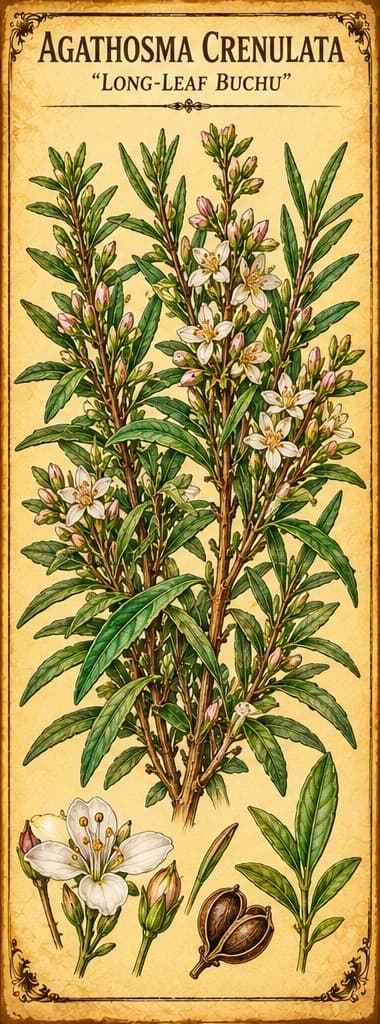
Agathosma Crenulata
Agathosma crenulata
Oval-leaf or long-leaf buchu, one of the two buchu species of South Africa, long used for urinary infections and other ailments.
Safety at a glance
- PregnancyNothing recorded
- BreastfeedingNothing recorded
- MedicinesNothing recorded
- Who should avoid itNothing recorded
- AllergiesNothing recorded
- Toxicity1 note →
Tap a box to read the safety notes below. “Nothing recorded” means our sources don't cover it, not that it's safe.
What is Agathosma Crenulata?
- Plant family
- Rutaceae, the citrus family
- Parts used
- The leaves and their essential oil
- Where it grows
- The Western Cape, South Africa
- Genus
- Agathosma
- Species
- crenulata
Also called
Oval-Leaf Buchu, Long-Leaf Buchu
Traditionally used for
- Urinary infections
- Colds
- Stomach problems (traditional)
Traditionally described as
- Aromatic; the oil is rich in pulegone
Traditions that use it
- African Traditional Medicine
One of the two buchu species of the Khoi-San.
Natural compounds
Safety
Toxicity testing
Its essential oil contains more pulegone than round-leaf buchu. Pulegone damaged the liver in rats at high doses, so the reviewers advise caution with this oil and prefer round-leaf buchu. Pulegone doesn't dissolve in water, so this caution doesn't apply to water extracts such as tea.[1]Study
What does the research say?
Traditional use
These are traditional uses, not proven treatments.
The Khoi-San used the word "buchu" for any fragrant plant that could be dried and powdered. Today it means two species: round-leaf buchu (Agathosma betulina) and this one, oval-leaf or long-leaf buchu.[2]Study
Buchu was used by the Khoisan for kidney and urinary infections, colds, stomach problems, rheumatism, gout and fever, and became a popular urinary remedy in Europe and the US in the 1800s. This species was dropped from the official American drug references by 1906, while round-leaf buchu stayed in longer.[1]Study
Laboratory & animal research
Lab and animal results show what might be worth studying in people. They don't show that the herb has these effects in humans.
In lab tests, the essential oils of both buchu species blocked an enzyme involved in inflammation, and leaf extracts had moderate antioxidant activity. There are no human trials.[1]Study
In short
Its oil contains more liver-toxic pulegone than round-leaf buchu.
Sources
- [1] Buchu (Agathosma betulina and A. crenulata): Rightfully Forgotten or Underutilized? · DOI: 10.3389/fphar.2022.813142Peer-reviewed study
- [2] 'Buchu' – Agathosma betulina and Agathosma crenulata (Rutaceae): A review · DOI: 10.1016/j.jep.2008.07.036Peer-reviewed study
This information is educational and traditional in nature, and is not a substitute for professional medical advice. Unfamiliar word? See what these words mean.