
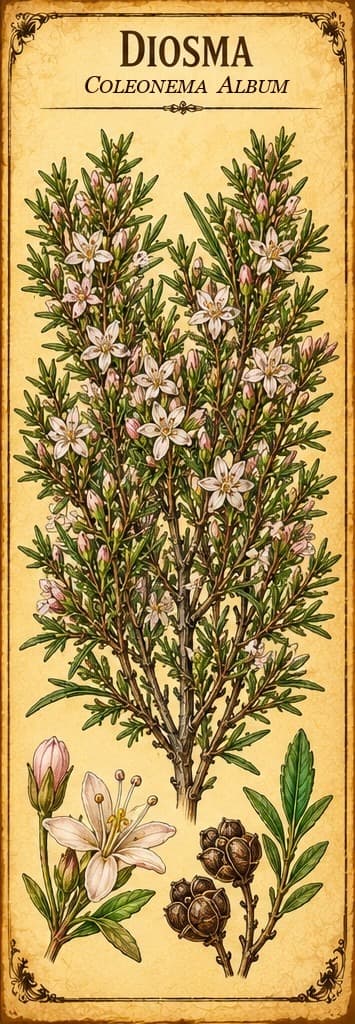
Diosma
Coleonema album
A fragrant South African shrub that the Khoisan rub on their skin. Its oil slowed a skin fungus in the lab.
Safety at a glance
- PregnancyNothing recorded
- BreastfeedingNothing recorded
- MedicinesNothing recorded
- Who should avoid itNothing recorded
- AllergiesNothing recorded
- ToxicityNothing recorded
Tap a box to read the safety notes below. “Nothing recorded” means our sources don't cover it, not that it's safe.
What is Diosma?
- Plant family
- Rutaceae, the citrus family
- Parts used
- The leaves and their essential oil
- Where it grows
- South Africa
- Genus
- Coleonema
- Species
- album
Traditionally used for
- Skin care
Traditionally described as
- Essential oil rich in terpenes
Traditions that use it
- African Traditional Medicine
Rubbed on the skin by the Khoisan.
What does the research say?
Traditional use
These are traditional uses, not proven treatments.
The Khoisan rub diosma on their skin to give it a shine, and it's used in skincare products.[1]Study
Laboratory & animal research
Lab and animal results show what might be worth studying in people. They don't show that the herb has these effects in humans.
In lab tests, diosma's essential oil, which is mostly terpenes, slowed the growth of Trichophyton rubrum, a fungus behind athlete's foot and ringworm. The researchers suggest it could be used in natural skin ointments.[1]Study
In short
No human or safety studies were found.
Sources
- [1] Antifungal and antioxidant activities of Coleonema album and C. pulchellum against skin diseases · DOI: 10.1080/13880209.2017.1296470Peer-reviewed study
This information is educational and traditional in nature, and is not a substitute for professional medical advice. Unfamiliar word? See what these words mean.