
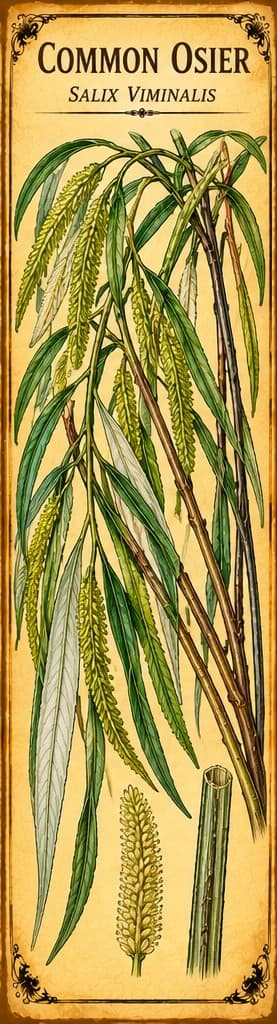
Common Osier
Salix viminalis
A basket willow, grown for weaving and medicine. Its buds are rich in the antioxidant catechin, and its bark contains salicylic acid.
Safety at a glance
- PregnancyNothing recorded
- BreastfeedingNothing recorded
- MedicinesNothing recorded
- Who should avoid itNothing recorded
- AllergiesNothing recorded
- ToxicityNothing recorded
Tap a box to read the safety notes below. “Nothing recorded” means our sources don't cover it, not that it's safe.
What is Common Osier?
- Plant family
- Salicaceae, the willow family
- Parts used
- The rods (stems) for basket-making; the buds and bark have been studied
- Genus
- Salix
- Species
- viminalis
Also called
Osier, Basket Willow
Traditionally used for
- Basket-making
Traditionally described as
- Contains catechin and salicylic acid
What does the research say?
Traditional use
These are traditional uses, not proven treatments.
Willows have long been grown for basket-making and for their medicinal value.[1]Study
Laboratory & animal research
Lab and animal results show what might be worth studying in people. They don't show that the herb has these effects in humans.
In a comparison of five willows, osier buds had the most catechin, an antioxidant also found in tea. In all of them, salicylic acid (a compound related to aspirin) was highest in the bark.[1]Study
In lab tests, an antioxidant extract made from osier wood helped up to 25% more cells survive oxidative damage.[2]Study
In short
No human or safety studies were found.
Sources
- [1] Quantitative distribution of flavan-3-ols, procyanidins, flavonols, flavanone and salicylic acid in five varieties of organic winter dormant Salix spp. by LC-MS/MS · DOI: 10.1016/j.heliyon.2024.e25129Peer-reviewed study
- [2] Biologically active constituents from Salix viminalis bio-oil and their protective activity against hydrogen peroxide-induced oxidative stress in Chinese hamster ovary cells · DOI: 10.1007/s12010-014-1171-0Peer-reviewed study
This information is educational and traditional in nature, and is not a substitute for professional medical advice. Unfamiliar word? See what these words mean.