
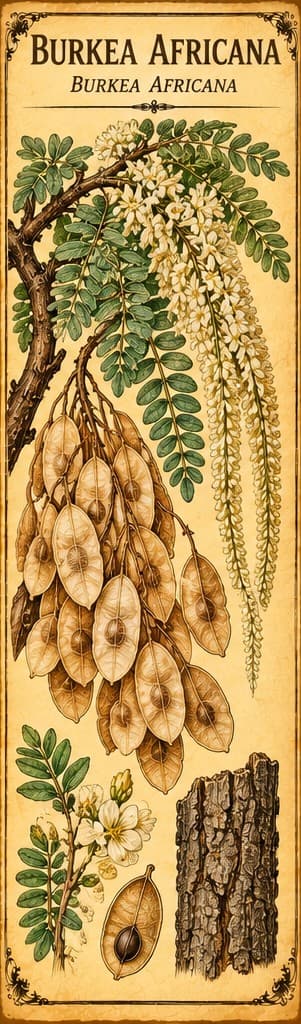
Burkea Africana
Burkea africana
An African tree whose stem bark is used for mouth sores, stomach problems and malaria. Lab and animal studies found activity against malaria and flu viruses.
Safety at a glance
- PregnancyNothing recorded
- BreastfeedingNothing recorded
- MedicinesNothing recorded
- Who should avoid itNothing recorded
- AllergiesNothing recorded
- ToxicityNothing recorded
Tap a box to read the safety notes below. “Nothing recorded” means our sources don't cover it, not that it's safe.
What is Burkea Africana?
- Plant family
- Fabaceae, the pea and bean family
- Parts used
- The stem bark
- Where it grows
- Tropical and subtropical Africa
- Genus
- Burkea
- Species
- africana
Traditionally used for
- Mouth sores
- Stomach problems
- Headache
- Malaria (traditional)
Traditionally described as
- Rich in tannin-type antioxidants
Traditions that use it
- African Traditional Medicine
Stem bark used in Mali and Nigeria.
Natural compounds
What does the research say?
Traditional use
These are traditional uses, not proven treatments.
In Mali, the powdered stem bark is put on mouth sores, and the bark has been used in folk medicine for stomach and bowel problems and headache. In Nigeria, the stem bark is a remedy for malaria.[1]Study
Laboratory & animal research
Lab and animal results show what might be worth studying in people. They don't show that the herb has these effects in humans.
In lab tests, a stem bark extract was moderately active against the malaria parasite, including a drug-resistant strain. In mice and rats it eased pain and brought down fever, and it caused no poisoning at the doses tested.[2]Study
In lab tests, saponins from the bark blocked flu viruses, including the 2009 pandemic flu strain, without harming the cells.[3]Study
The bark is rich in tannin-type antioxidants, which may explain its traditional use on wounds. Little scientific research has been done, and clinical studies are needed.[1]Study
In short
No human or safety studies were found.
Sources
- [1] Ethnopharmacology, Chemistry and Biological Properties of Four Malian Medicinal Plants · DOI: 10.3390/plants6010011Peer-reviewed study
- [2] Antiplasmodial, antinociceptive and antipyretic potential of the stem bark extract of Burkea africana and identification of its antiplasmodial-active fraction · DOI: 10.1016/j.jtcme.2020.12.004Peer-reviewed study
- [3] Anti-Influenza Triterpene Saponins from the Bark of Burkea africana · DOI: 10.1021/acs.jnatprod.7b00774Peer-reviewed study
This information is educational and traditional in nature, and is not a substitute for professional medical advice. Unfamiliar word? See what these words mean.