
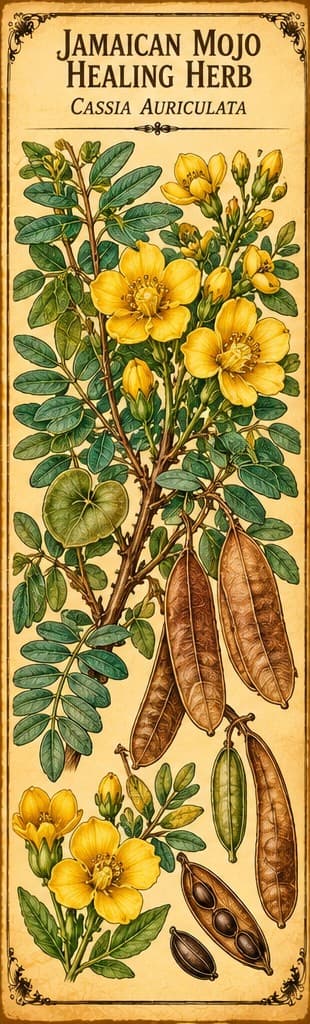
Jamaican Mojo Healing Herb
Senna auriculata
Avaram (Cassia auriculata), a yellow-flowered shrub used in Ayurveda and Siddha medicine, especially for diabetes. A small trial of an herbal powder containing it lowered blood sugar.
Safety at a glance
- PregnancyNothing recorded
- BreastfeedingNothing recorded
- Medicines1 note →
- Who should avoid itNothing recorded
- AllergiesNothing recorded
- ToxicityNothing recorded
Tap a box to read the safety notes below. “Nothing recorded” means our sources don't cover it, not that it's safe.
Jamaican Mojo Healing Herb may interact with some medicines. If you take any medicine, read Interactions with medicines below and talk to your doctor or pharmacist before using it.
What is Jamaican Mojo Healing Herb?
- Plant family
- Fabaceae, the pea and bean family
- Parts used
- The flowers, leaves, seeds, bark and roots
- Where it grows
- India and Sri Lanka
- Genus
- Senna
- Species
- auriculata
Regional names
Avaram
Traditional names
Avartaki
Older scientific names
Cassia auriculata
Traditionally used for
- Diabetes
- Asthma
- Rheumatism
- Skin disease (traditional)
Traditionally described as
- Lowers blood sugar (lab
- animal and one small trial)
Traditions that use it
- Ayurveda
Called avartaki; also used in Siddha medicine.
Safety
Interactions with medicines
A tea made from the flowers raised blood levels of the asthma drug theophylline, and in rats raised levels of the epilepsy drug carbamazepine. The review advises people taking either drug to avoid this tea. It may also add to the effect of diabetes medicines such as metformin.[1]Study
What does the research say?
Traditional use
These are traditional uses, not proven treatments.
Called avartaki, it is widely used in Ayurveda and Siddha medicine in India. Almost every part of the plant is used, traditionally for diabetes, asthma, rheumatism, dysentery and skin disease.[1]Study
Laboratory & animal research
Lab and animal results show what might be worth studying in people. They don't show that the herb has these effects in humans.
In lab and animal studies, extracts lowered blood sugar and blood fats, acted as antioxidants and reduced inflammation, and protected the liver and kidneys. Animal toxicity studies found no signs of poisoning.[1]Study
Research in people
In a two-month trial in people with type 2 diabetes, an Ayurvedic herbal powder with this plant as its main ingredient eased symptoms such as frequent urination, hunger and thirst, and lowered blood sugar. It was compared with the diabetes drug glimepiride. Larger human studies are needed.[1]Study
In short
Its flower tea can raise blood levels of theophylline and carbamazepine.
Sources
- [1] Ethnopharmacological, Phytochemical, Pharmacological, and Toxicological Review on Senna auriculata (L.) Roxb.: A Special Insight to Antidiabetic Property · DOI: 10.3389/fphar.2021.647887Peer-reviewed study
This information is educational and traditional in nature, and is not a substitute for professional medical advice. Unfamiliar word? See what these words mean.