
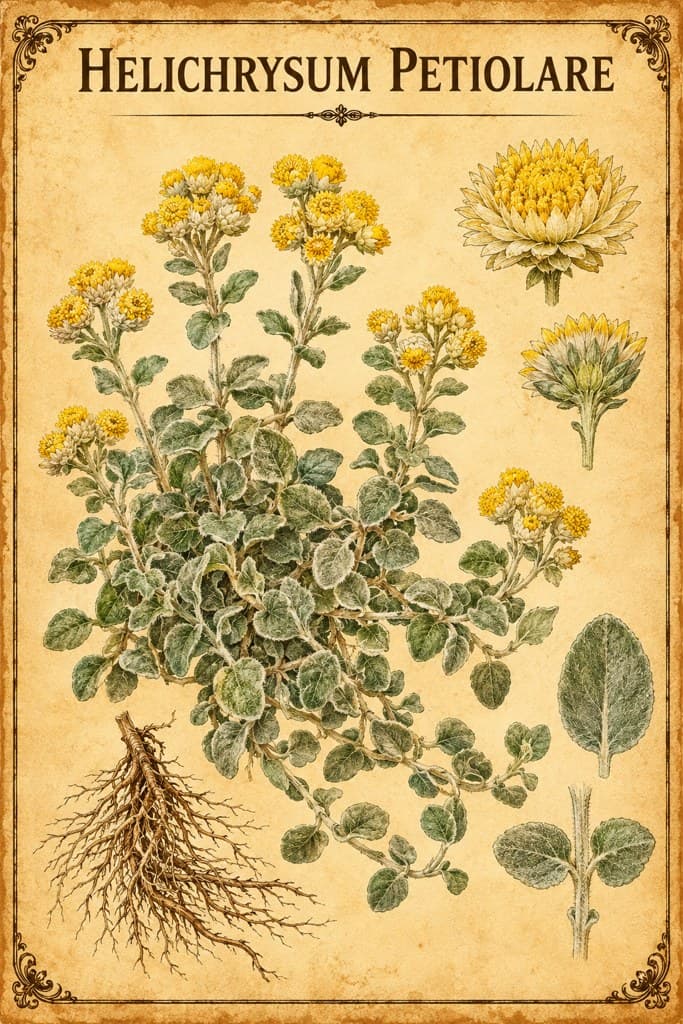
Helichrysum Petiolare
Helichrysum petiolare
Licorice plant or kooigoed, a silvery South African everlasting used for colds, coughs, fever, menstrual problems and skin care. Lab studies suggest it may help with blood sugar.
Safety at a glance
- PregnancyNothing recorded
- BreastfeedingNothing recorded
- MedicinesNothing recorded
- Who should avoid itNothing recorded
- AllergiesNothing recorded
- Toxicity1 note →
Tap a box to read the safety notes below. “Nothing recorded” means our sources don't cover it, not that it's safe.
What is Helichrysum Petiolare?
- Plant family
- Asteraceae, the daisy family
- Parts used
- The leaves
- Where it grows
- South Africa
- Genus
- Helichrysum
- Species
- petiolare
Also called
Licorice Plant, Silverbush Everlasting
Regional names
Kooigoed
Traditionally used for
- Colds
- Coughs
- Fever
- Menstrual problems
- Skin care (traditional)
Traditionally described as
- Silvery
- aromatic leaves
Traditions that use it
- African Traditional Medicine
Used in South Africa for colds, coughs, fever, menstrual problems and skin care.
Safety
Toxicity testing
In one lab study, an extract damaged the DNA of normal cells. In another, an extract protected bacteria from DNA damage.[1]Study
What does the research say?
Traditional use
These are traditional uses, not proven treatments.
Helichrysum plants, the everlastings, have been used for more than 2,000 years. In South Africa they are drunk as teas or burned as smoke to cleanse the homes of sick people and to ask the ancestors for blessings.[1]Study
In South African traditional medicine, licorice plant is used for fever, catarrh, colds, coughs, chest problems, menstrual problems, kidney infections, high blood pressure and erectile dysfunction. A tea of the leaves is used in beauty treatments to improve the skin and to heal wounds. In the Eastern Cape it is also used for type 2 diabetes.[1]Study
Laboratory & animal research
Lab and animal results show what might be worth studying in people. They don't show that the herb has these effects in humans.
In lab tests, leaf extracts were active against Staphylococcus aureus and Bacillus cereus bacteria, though the essential oil was not. An extract also lowered signs of cell damage and inflammation without harming human skin cells.[1]Study
In lab tests, water extracts helped muscle and liver cells take up sugar and blocked enzymes that break down starch, about as well as the diabetes drug acarbose. An alcohol extract was toxic to the cells.[2]Study
In a second lab study, an extract blocked the same starch-digesting enzymes and increased sugar uptake into cells.[3]Study
In short
One lab study found an extract damaged the DNA of normal cells.
Sources
- [1] Medicinal Properties and In Vitro Biological Activities of Selected Helichrysum Species from South Africa: A Review · DOI: 10.3390/plants10081566Peer-reviewed study
- [2] In vitro evaluation of the anti-diabetic potential of Helichrysum petiolare Hilliard & B.L. Burtt using HepG2 (C3A) and L6 cell lines · DOI: 10.12688/f1000research.26855.2Peer-reviewed study
- [3] In Vitro Evaluation of the Anti-Diabetic Potential of Aqueous Acetone Helichrysum petiolare Extract (AAHPE) with Molecular Docking Relevance in Diabetes Mellitus · DOI: 10.3390/molecules27010155Peer-reviewed study
This information is educational and traditional in nature, and is not a substitute for professional medical advice. Unfamiliar word? See what these words mean.