
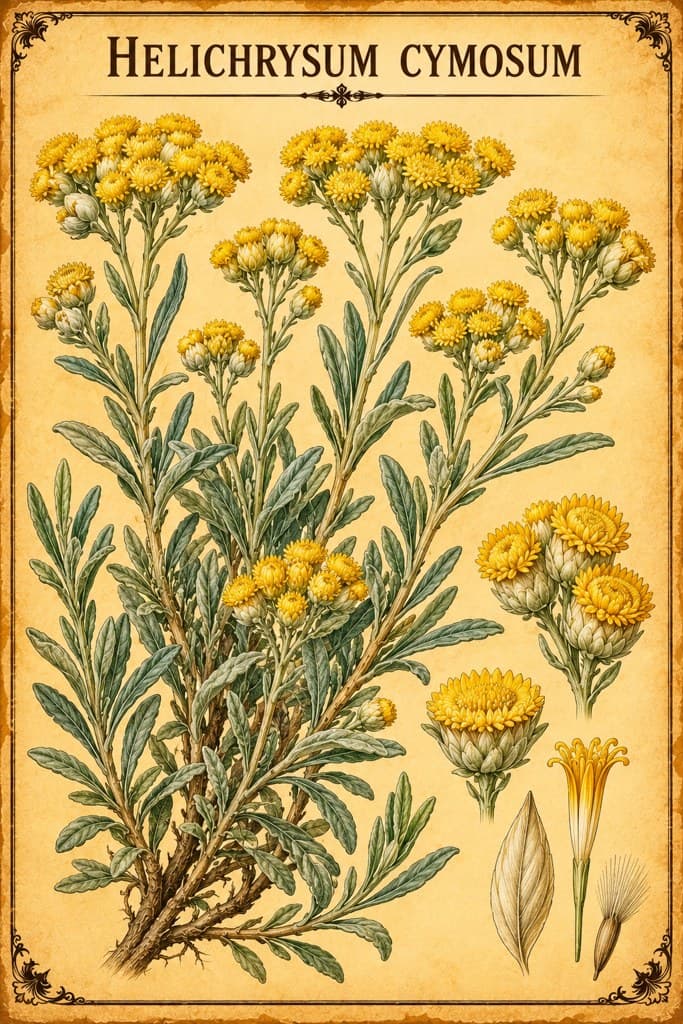
Helichrysum Cymosum
Helichrysum cymosum
Gold carpet, a silvery South African everlasting with yellow flower heads, used for coughs, colds, fever, menstrual pain and wounds. Its oil was active against the malaria parasite in the lab.
Safety at a glance
- PregnancyNothing recorded
- BreastfeedingNothing recorded
- MedicinesNothing recorded
- Who should avoid itNothing recorded
- AllergiesNothing recorded
- Toxicity1 note →
Tap a box to read the safety notes below. “Nothing recorded” means our sources don't cover it, not that it's safe.
What is Helichrysum Cymosum?
- Plant family
- Asteraceae, the daisy family
- Parts used
- The above-ground parts, leaves and roots
- Where it grows
- South Africa (Eastern Cape, KwaZulu-Natal and Western Cape)
- Genus
- Helichrysum
- Species
- cymosum
Also called
Gold Carpet, Yellow-Tipped Strawflower
Regional names
Goue Tapyt, Imphepho
Traditionally used for
- Coughs
- Colds
- Fever
- Menstrual pain
- Wounds (traditional)
Traditionally described as
- Aromatic essential oil
Traditions that use it
- African Traditional Medicine
Used in South Africa for coughs, colds, fever, menstrual pain and wounds.
Natural compounds
Safety
Toxicity testing
In lab tests, the essential oil was the most toxic of the plant's extracts to kidney cells.[1]Study
What does the research say?
Traditional use
These are traditional uses, not proven treatments.
Laboratory & animal research
Lab and animal results show what might be worth studying in people. They don't show that the herb has these effects in humans.
In lab tests, its essential oil was strongly active against the malaria parasite, though much weaker than the drugs quinine and chloroquine. A compound from the plant, helihumulone, was active against Candida and Cryptococcus fungi, and the oil was a strong antioxidant. The oil didn't work against the bacteria tested.[1]Study
In short
Its essential oil was toxic to kidney cells in the lab.
Sources
- [1] Medicinal Properties and In Vitro Biological Activities of Selected Helichrysum Species from South Africa: A Review · DOI: 10.3390/plants10081566Peer-reviewed study
- [2] Helichrysum Genus and Compound Activities in the Management of Diabetes Mellitus · DOI: 10.3390/plants11101386Peer-reviewed study
This information is educational and traditional in nature, and is not a substitute for professional medical advice. Unfamiliar word? See what these words mean.