
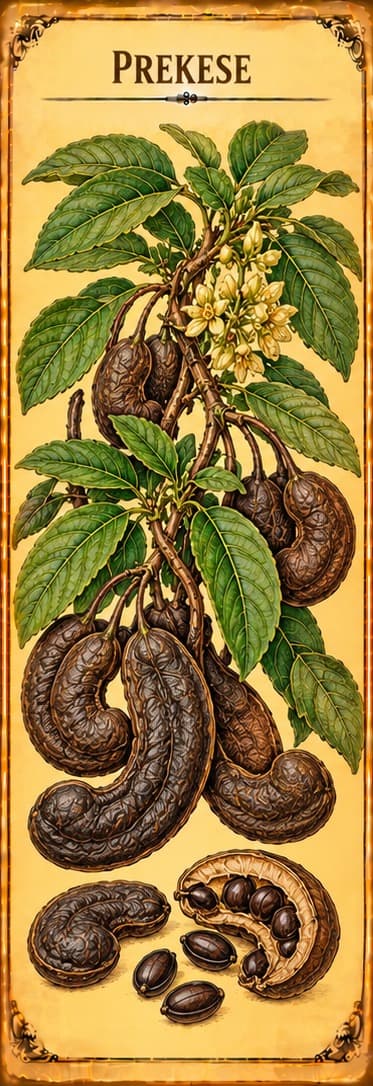
Prekese
Tetrapleura tetraptera
Aidan fruit, the dried pod of a West African tree, widely used in traditional medicine. It caused no poisoning in rodent studies.
Safety at a glance
- PregnancyNothing recorded
- BreastfeedingNothing recorded
- MedicinesNothing recorded
- Who should avoid itNothing recorded
- AllergiesNothing recorded
- Toxicity1 note →
Tap a box to read the safety notes below. “Nothing recorded” means our sources don't cover it, not that it's safe.
What is Prekese?
- Plant family
- Fabaceae, the pea and bean family
- Parts used
- The dried fruit (pod)
- Where it grows
- West Africa
- Genus
- Tetrapleura
- Species
- tetraptera
Also called
Aidan Fruit
Traditionally used for
- Various ailments (traditional)
Traditionally described as
- Aromatic dried pod
Traditions that use it
- African Traditional Medicine
A widely used medicinal fruit in West Africa.
Safety
Toxicity testing
A man who took an herbal product containing prekese, Alstonia boonei and papaya extracts for fatty liver developed serious liver and kidney damage, which improved after he stopped. Prekese extracts have been linked to liver damage in animal studies.[1]Study
What does the research say?
Traditional use
These are traditional uses, not proven treatments.
Prekese is a widely used medicinal plant in West Africa, traditionally taken for various ailments.[2]Study
Laboratory & animal research
Lab and animal results show what might be worth studying in people. They don't show that the herb has these effects in humans.
In mice and rats, a hot water extract of the fruit caused no poisoning, even at high doses. It contains compounds that may calm the nervous system, which researchers want to study further.[2]Study
In short
Linked to liver damage in animal studies and, in one case, in a mixed herbal product.
Sources
- [1] Complementary and Alternative Medicine-Induced Combined Hepatorenal Toxicity: A Case Report · DOI: 10.7759/cureus.100197Peer-reviewed study
- [2] Unveiling phytochemical diversity and safety profile of hot water extract from Tetrapleura tetraptera fruit · DOI: 10.1186/s12906-024-04681-1Peer-reviewed study
This information is educational and traditional in nature, and is not a substitute for professional medical advice. Unfamiliar word? See what these words mean.