
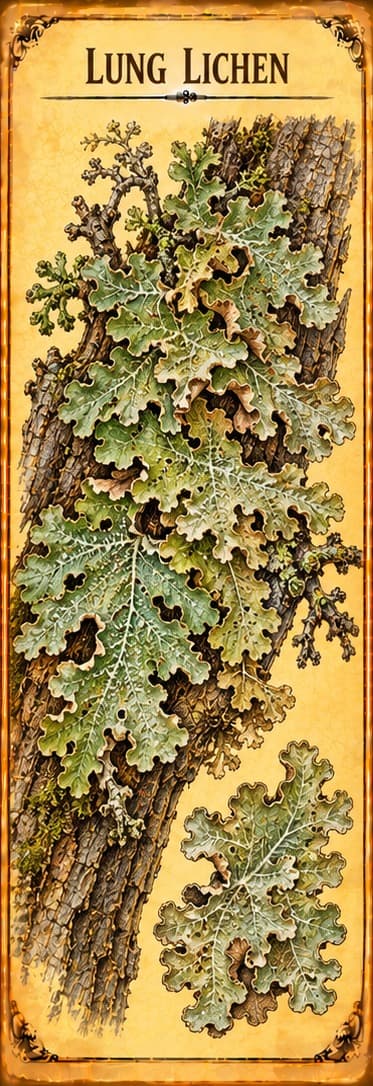
Lung Lichen
Lobaria pulmonaria
A leafy forest lichen that looks like lung tissue and has been used for lung problems since the 1400s. In the lab it was active against drug-resistant tuberculosis.
Safety at a glance
- PregnancyNothing recorded
- BreastfeedingNothing recorded
- MedicinesNothing recorded
- Who should avoid itNothing recorded
- AllergiesNothing recorded
- ToxicityNothing recorded
Tap a box to read the safety notes below. “Nothing recorded” means our sources don't cover it, not that it's safe.
What is Lung Lichen?
- Plant family
- Lobariaceae, a family of leafy lichens
- Parts used
- The whole lichen
- Where it grows
- Old forests of Europe, Asia, North America and Africa, growing on tree bark
- Genus
- Lobaria
- Species
- pulmonaria
Also called
Lungwort Lichen, Oak Lung
Traditionally used for
- Tuberculosis
- Coughs (traditional)
Traditionally described as
- Contains stictic acid
Natural compounds
What does the research say?
Traditional use
These are traditional uses, not proven treatments.
Lung lichen is a leafy lichen, not a plant. Its lobed surface looks like lung tissue, and since the late 1400s many cultures have used it for lung problems such as tuberculosis, coughs and coughing up blood.[1]Study
Laboratory & animal research
Lab and animal results show what might be worth studying in people. They don't show that the herb has these effects in humans.
In lab tests, a lung lichen extract stopped the growth of tuberculosis bacteria, including six drug-resistant strains, more strongly than the TB drug rifampicin, without harming human immune cells. It hasn't been tested in people.[1]Study
It is one of several lichens eaten in some places. In a comparison of five edible lichens, it was the weakest against common bacteria.[2]Study
In short
No human or safety studies were found.
Sources
- [1] Secondary metabolites from Lobaria pulmonaria (L.) Hoffm. target key metabolic enzymes: a novel strategy against multidrug-resistant tuberculosis · DOI: 10.1039/d5ra05774dPeer-reviewed study
- [2] Optimizing the Extraction of Polyphenols from Different Edible Lichens Using Response Surface Methodology and the Determination of Their Mineral and Antibacterial Properties · DOI: 10.3390/foods14152562Peer-reviewed study
This information is educational and traditional in nature, and is not a substitute for professional medical advice. Unfamiliar word? See what these words mean.