
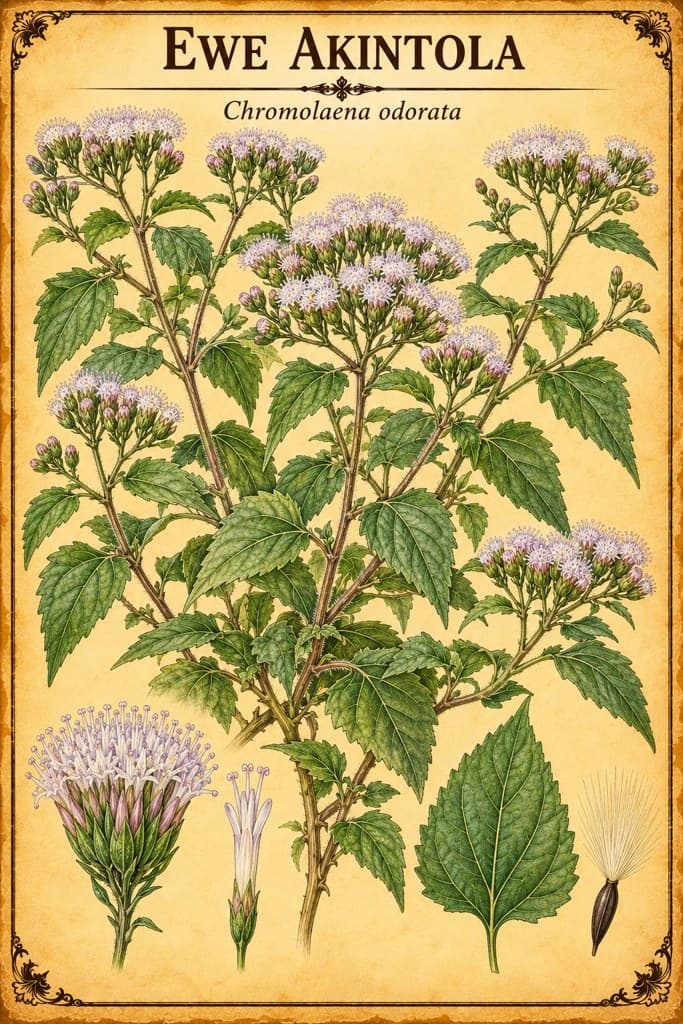
Ewe Akintola
Chromolaena odorata
Siam weed, used by the Yoruba to stop bleeding and on fresh wounds, and for malaria and skin disease. Its leaf extract killed wound bacteria in the lab.
Safety at a glance
- PregnancyNothing recorded
- BreastfeedingNothing recorded
- MedicinesNothing recorded
- Who should avoid itNothing recorded
- AllergiesNothing recorded
- ToxicityNothing recorded
Tap a box to read the safety notes below. “Nothing recorded” means our sources don't cover it, not that it's safe.
What is Ewe Akintola?
- Plant family
- Asteraceae, the daisy family
- Parts used
- The leaves
- Where it grows
- The Americas; now a widespread weed in Africa and Asia
- Genus
- Chromolaena
- Species
- odorata
Also called
Siam Weed
Regional names
Akintola
Traditionally used for
- Bleeding
- Wounds
- Malaria
- Skin disease (traditional)
Traditionally described as
- Antibacterial leaf extract (lab)
Traditions that use it
- African Traditional Medicine
Yoruba use of the leaf to stop bleeding and for fresh wounds, malaria and skin disease.
What does the research say?
Traditional use
These are traditional uses, not proven treatments.
Among the Yoruba of southwestern Nigeria, akintola is used to stop bleeding and on fresh wounds, and for malaria, toothache, skin disease, diarrhea, headache and hemorrhoids. It's also used in body creams.[1]Study
Laboratory & animal research
Lab and animal results show what might be worth studying in people. They don't show that the herb has these effects in humans.
Siam weed is one of the main plants studied for stopping bleeding and healing wounds. In lab tests its leaf extract killed Staphylococcus aureus bacteria, including when added to a liquid wound plaster. Most studies used crude extracts, not tested in people.[2]Study
In short
No human or safety studies were found.
Sources
- [1] Wandering through southwestern Nigeria: An inventory of Yoruba useful angiosperm plants · DOI: 10.1016/j.heliyon.2021.e08668Peer-reviewed study
- [2] Plant-derived modulators of the hemostasis-wound healing axis: mechanisms, evidence, and translational potentialPeer-reviewed study
This information is educational and traditional in nature, and is not a substitute for professional medical advice. Unfamiliar word? See what these words mean.