
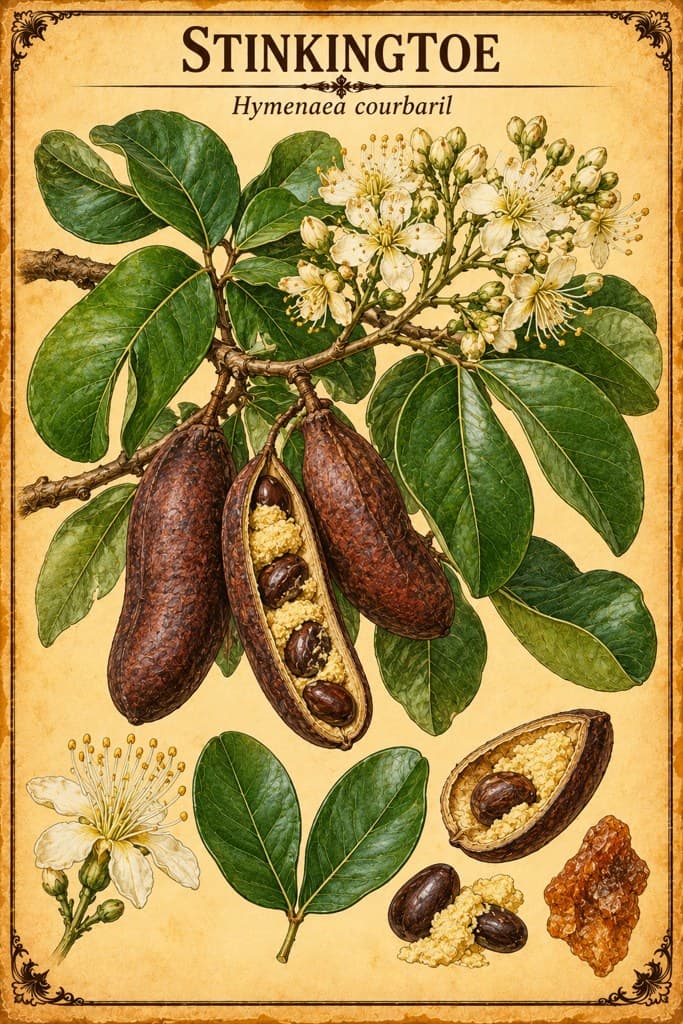
Stinkingtoe
Hymenaea courbaril
Jatobá, a tropical American tree with large woody pods of edible pulp, used in Brazil for wounds, coughs, rheumatism and stomach problems.
Safety at a glance
- PregnancyNothing recorded
- BreastfeedingNothing recorded
- MedicinesNothing recorded
- Who should avoid itNothing recorded
- AllergiesNothing recorded
- ToxicityNothing recorded
Tap a box to read the safety notes below. “Nothing recorded” means our sources don't cover it, not that it's safe.
What is Stinkingtoe?
- Plant family
- Fabaceae, the pea and bean family
- Parts used
- The fruit pulp, bark, leaves and resin
- Where it grows
- Tropical Central and South America and the Caribbean
- Genus
- Hymenaea
- Species
- courbaril
Also called
Jatobá, West Indian Locust, Courbaril
Traditionally used for
- Edible pulp
- Wounds
- Coughs
- Rheumatism (traditional)
Traditionally described as
- Edible fruit pulp and resin
Traditions that use it
- Caribbean Folk Medicine
A tropical American tree whose fruit is eaten and whose parts are used as medicine.
What does the research say?
Traditional use
These are traditional uses, not proven treatments.
Native peoples have long used stinkingtoe for food, medicine and its tough wood. Its pods hold an edible, powdery pulp. In Brazilian traditional medicine it's used for wounds, inflammation, infections, rheumatism, anemia, coughs, bronchitis, stomach problems and prostate problems.[1]Study
Laboratory & animal research
Lab and animal results show what might be worth studying in people. They don't show that the herb has these effects in humans.
In lab studies, extracts fought bacteria, fungi and viruses, calmed inflammation, acted as antioxidants and relaxed muscle. Animal tests found it has low toxicity.[1]Study
In lab tests and in mice, extracts of the pod coat blocked a starch-digesting enzyme and reduced the rise in blood sugar after eating starch.[2]Study
In short
Animal tests found low toxicity; no human studies were found.
Sources
- [1] Chemical and Biological Properties of Hymenaea courbaril L.: A Review · DOI: 10.1002/cbdv.202503154Peer-reviewed study
- [2] Inhibitory Effects of Aqueous and Hydroalcoholic Extracts from Jatobá Coat (Hymenaea courbaril L.) on Pancreatic Amylase and Starch Absorption · DOI: 10.3390/plants14071133Peer-reviewed study
This information is educational and traditional in nature, and is not a substitute for professional medical advice. Unfamiliar word? See what these words mean.