
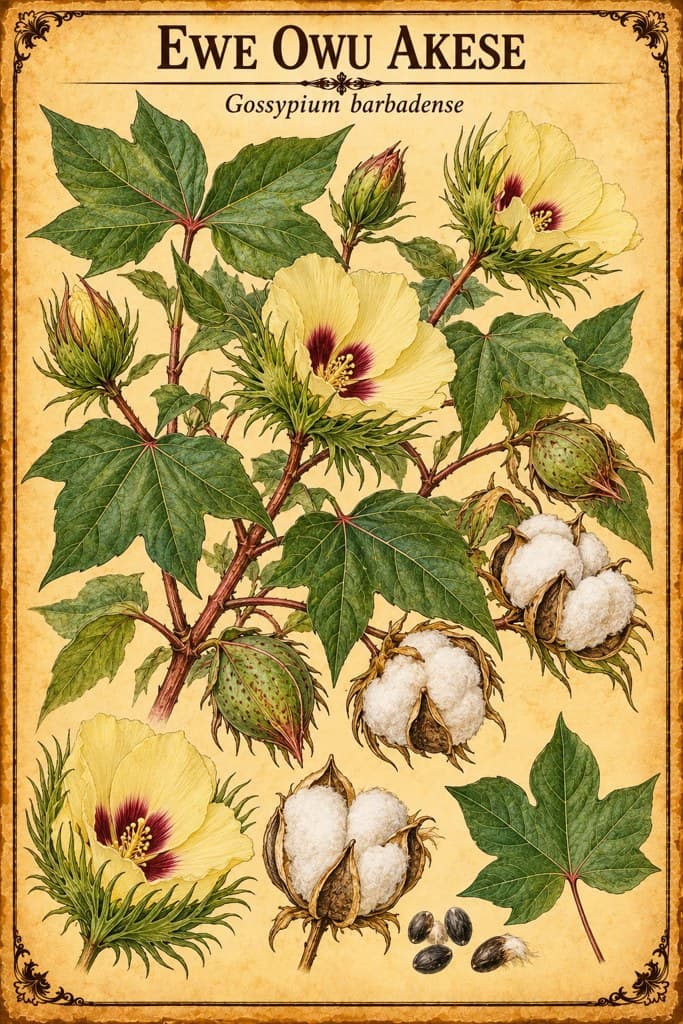
Ewe Owu Akese
Gossypium barbadense
Sea-island cotton leaves, used by the Yoruba for infertility, malaria, ulcers and wounds, and in the Caribbean for itchy skin, bellyache and cuts.
Safety at a glance
- Pregnancy1 note →
- BreastfeedingNothing recorded
- MedicinesNothing recorded
- Who should avoid itNothing recorded
- AllergiesNothing recorded
- ToxicityNothing recorded
Tap a box to read the safety notes below. “Nothing recorded” means our sources don't cover it, not that it's safe.
What is Ewe Owu Akese?
- Plant family
- Malvaceae, the mallow family
- Parts used
- The leaves
- Where it grows
- Tropical South America; grown in West Africa and the Caribbean
- Genus
- Gossypium
- Species
- barbadense
Also called
Sea Island Cotton
Regional names
Owu Akese
Traditionally used for
- Infertility
- Malaria
- Wounds
- Bellyache
- Itchy skin (traditional)
Traditionally described as
- Medicinal leaves
Traditions that use it
- African Traditional Medicine
Yoruba use of the leaf for infertility, malaria, wounds and ulcers.
- Caribbean Folk Medicine
Leaves used for skin problems, bellyache and wind, and cuts.
Safety
Pregnancy
There isn't enough information to recommend it during pregnancy, while breastfeeding or for children under 12.[1]Traditional text
What does the research say?
Traditional use
These are traditional uses, not proven treatments.
Among the Yoruba of southwestern Nigeria, owu akese is used for female infertility, malaria, ulcers and as a wound dressing.[2]Study
In the Caribbean, TRAMIL recognizes three traditional uses of the leaves: crushed leaves rubbed on itchy skin conditions, a leaf tea for bellyache and wind, and leaf juice on bleeding cuts.[1]Traditional text
Laboratory & animal research
Lab and animal results show what might be worth studying in people. They don't show that the herb has these effects in humans.
In mice, a leaf tea extract caused no poisoning, and the leaves didn't irritate rabbit skin.[1]Traditional text
In short
Not enough information for use in pregnancy, breastfeeding or children under 12.
Sources
- [1] Gossypium barbadense — TRAMIL (Traditional Medicine in the Islands)Traditional text
- [2] Wandering through southwestern Nigeria: An inventory of Yoruba useful angiosperm plants · DOI: 10.1016/j.heliyon.2021.e08668Peer-reviewed study
This information is educational and traditional in nature, and is not a substitute for professional medical advice. Unfamiliar word? See what these words mean.