
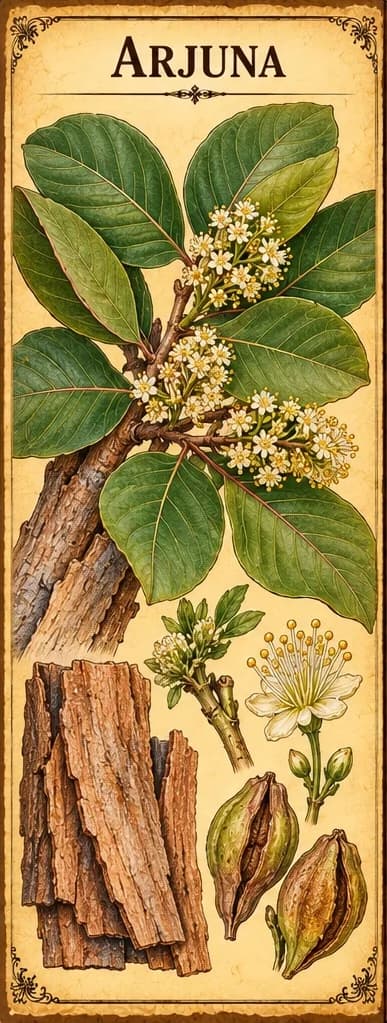
Arjuna
Terminalia arjuna
The bark of a large Indian tree, used in Ayurveda for centuries as a heart tonic. Trials for chest pain (angina) were too poor in quality to show whether it helps.
Safety at a glance
- PregnancyNothing recorded
- BreastfeedingNothing recorded
- MedicinesNothing recorded
- Who should avoid itNothing recorded
- AllergiesNothing recorded
- ToxicityNothing recorded
Tap a box to read the safety notes below. “Nothing recorded” means our sources don't cover it, not that it's safe.
What is Arjuna?
- Plant family
- Combretaceae, the combretum family
- Parts used
- Mainly the bark
- Where it grows
- India, Sri Lanka, Myanmar and Mauritius
- Genus
- Terminalia
- Species
- arjuna
Traditional names
Indradru, Partha, Veeravriksha
Traditionally used for
- Heart tonic
- Heart failure
- Fractures
- Ulcers
- Liver problems
- Anemia (traditional)
Traditionally described as
- Heart tonic
Health topics
Where Arjuna appears in symptom search, and why. Being listed doesn't mean it's a proven treatment.
- Heart Failure
Traditional use only: in Ayurveda the bark is used as a heart tonic, including for heart failure. Trials for chest pain (angina) were too poor to show a benefit.
- High Blood Sugar
In one small 3-month study, arjuna bark plus metformin improved blood sugar about as much as sitagliptin plus metformin. There was no placebo group.
Traditions that use it
- Ayurveda
The bark is used as a heart tonic, and for fractures, ulcers, liver problems and anemia.
Safety
Side effects
No side effects were seen in 30 people who took arjuna bark with metformin for 3 months.[1]Study
What does the research say?
Traditional use
These are traditional uses, not proven treatments.
In Ayurveda, the bark has been used for centuries as a heart tonic, including for heart failure and other heart conditions. It has also been used for fractures, ulcers, liver problems, blood disorders and anemia.[2]Study
Laboratory & animal research
Lab and animal results show what might be worth studying in people. They don't show that the herb has these effects in humans.
In lab tests on rat heart muscle cells, a water extract of the bark made the cells contract more strongly and relax faster. Lab and animal studies also report antioxidant activity and effects on blood pressure and blood fats.[2]Study
Technical detail: positive inotropy and faster relaxation in adult rat ventricular myocytes, attributed to enhanced sarcoplasmic reticulum function; saponin glycosides and flavonoids are thought to be the active compounds.
Research in people
A 2014 review looked at trials of arjuna in people with chronic stable angina, chest pain caused by narrowed heart arteries. The trials were poorly designed. Where results could be combined, arjuna did no better than the comparison treatments. The authors concluded there isn't enough evidence for or against it, and that larger, well-run trials are needed.[3]Review or trial
Technical detail: systematic review and meta-analysis of randomized, pseudo-randomized and before-after studies against standard treatment; no significant difference in pooled outcomes.
In a 3-month study in India, 60 people with type 2 diabetes took metformin plus either 1 g of arjuna bark or the diabetes medicine sitagliptin. Fasting blood sugar and HbA1c (a measure of blood sugar over about 3 months) improved similarly in both groups. No side effects were seen in the arjuna group. The study was small and had no placebo group.[1]Study
Technical detail: metformin 500 mg twice daily in both groups; sitagliptin 100 mg once daily; fasting blood sugar, liver tests and side effects checked at 4, 8 and 12 weeks.
In short
Trials for chest pain (angina) were poor quality, so any benefit is unproven.
Sources
- [1] Clinical study evaluating antihyperglycemic efficacy and safety of terminalia arjuna versus sitagliptin in Type-2 diabetes mellitus patients · DOI: 10.6026/9732063002001862Peer-reviewed study
- [2] Medicinal properties of Terminalia arjuna (Roxb.) Wight & Arn.: A review · DOI: 10.1016/j.jtcme.2016.02.003Peer-reviewed study
- [3] Terminalia arjuna in Chronic Stable Angina: Systematic Review and Meta-Analysis · DOI: 10.1155/2014/281483Review or clinical trial
This information is educational and traditional in nature, and is not a substitute for professional medical advice. Unfamiliar word? See what these words mean.