
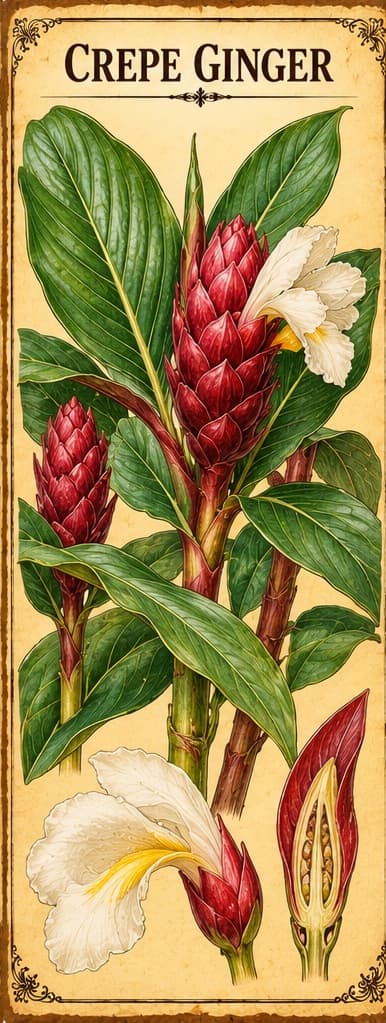
Crepe Ginger
Hellenia speciosa
A plant from South East Asia whose rhizome is traditionally used for inflammation and pain. In Puerto Rico it's used alongside diabetes treatment, and one small study tested rhizome nose drops for sore throat.
Safety at a glance
- PregnancyNothing recorded
- BreastfeedingNothing recorded
- MedicinesNothing recorded
- Who should avoid itNothing recorded
- AllergiesNothing recorded
- ToxicityNothing recorded
Tap a box to read the safety notes below. “Nothing recorded” means our sources don't cover it, not that it's safe.
What is Crepe Ginger?
- Plant family
- Costaceae, the spiral ginger family
- Parts used
- Mainly the rhizome (underground stem); the leaves are also studied
- Where it grows
- South East Asia, especially India, Sri Lanka, Indonesia and Malaysia
- Genus
- Hellenia
- Species
- speciosa
Older scientific names
Costus speciosus, Cheilocostus speciosus
Traditionally used for
- Inflammation
- Pain
- Diabetes (traditional)
Traditionally described as
- Medicinal rhizome
Health topics
Where Crepe Ginger appears in symptom search, and why. Being listed doesn't mean it's a proven treatment.
- High Blood Sugar
Used in Puerto Rico alongside diabetes treatment. A root extract lowered blood sugar in diabetic rats; it hasn't been tested for this in people.
- Sore Throat
In one small study without a comparison group, most people using rhizome nose drops for a sore throat or tonsillitis got better within 5 days.
Traditions that use it
- Caribbean Folk Medicine
Used in Puerto Rico alongside treatment for diabetes.
How it's prepared
Common ways Crepe Ginger is prepared or sold. This isn't advice on how to take it; see Safety below.
Safety
Side effects
No side effects were recorded in a small study of 15 people who used rhizome nose drops for 3 days.[1]Study
What does the research say?
Traditional use
These are traditional uses, not proven treatments.
Laboratory & animal research
Lab and animal results show what might be worth studying in people. They don't show that the herb has these effects in humans.
In rats, an alcohol-based rhizome extract reduced swelling at high doses, but had only a minimal effect on fever.[2]Study
Technical detail: ethanolic extract; carrageenan paw edema at 800 mg/kg and cotton pellet granuloma at 400 and 800 mg/kg; yeast-induced pyrexia only at 800 mg/kg.
In diabetic rats, a root extract given for 4 weeks lowered blood sugar and raised insulin levels.[4]Study
Technical detail: streptozotocin-induced diabetes; ethanolic extract at 400 and 600 mg/kg; raised glucokinase, pyruvate kinase and other glucose-processing enzymes, compared with glibenclamide.
In lab tests, a water extract of the leaves slowed the flu virus in cells. Given by mouth to mice, it was safe and protected them against several flu strains.[5]Study
Technical detail: influenza A H1N1, H3N2 and H9N2; EC50 15.19 μg/mL in RAW264.7 cells; cinnamic, caffeic and chlorogenic acids identified as likely active compounds.
In lab tests, compounds from the plant, including diosgenin and costunolide, slowed or killed several kinds of cancer cells.[6]Study
Technical detail: reported mechanisms include up-regulation of Bax, intracellular calcium and reactive oxygen species.
Research in people
In a small study in Saudi Arabia, 15 children and adults with a sudden sore throat or tonsillitis used nose drops made from a water extract of the rhizome every 8 hours for 3 days. Symptoms improved in 60% within 24 hours, and 93% were better by day 5. No side effects were recorded.
There was no comparison group, so the study can't show whether the drops caused the improvement.[1]Study
Technical detail: pilot cohort study; 15–30 drops every 8 hours.
In short
Barely studied in people, so its safety is unknown.
Sources
- [1] Evaluating the therapeutic efficacy, tolerability, and safety of an aqueous extract of Costus speciosus rhizome in acute pharyngitis and acute tonsillitis. A pilot study · DOI: 10.15537/smj.2015.8.11377Peer-reviewed study
- [2] Anti-inflammatory and antipyretic properties of the rhizome of Costus speciosus (Koen.) Sm.Peer-reviewed study
- [3] Chemical profile and in vivo hypoglycemic effects of Syzygium jambos, Costus speciosus and Tapeinochilos ananassae plant extracts used as diabetes adjuvants in Puerto Rico · DOI: 10.1186/s12906-015-0772-7Peer-reviewed study
- [4] Molecular mechanisms of anti-hyperglycemic effects of Costus speciosus extract in streptozotocin-induced diabetic ratsPeer-reviewed study
- [5] The Aqueous Leaf Extract of the Medicinal Herb Costus speciosus Suppresses Influenza A H1N1 Viral Activity under In Vitro and In Vivo Conditions · DOI: 10.3390/v15061375Peer-reviewed study
- [6] Possible Anticancer Mechanisms of Some Costus speciosus Active Ingredients Concerning Drug Discovery · DOI: 10.2174/1570163813666160802154403Peer-reviewed study
This information is educational and traditional in nature, and is not a substitute for professional medical advice. Unfamiliar word? See what these words mean.