
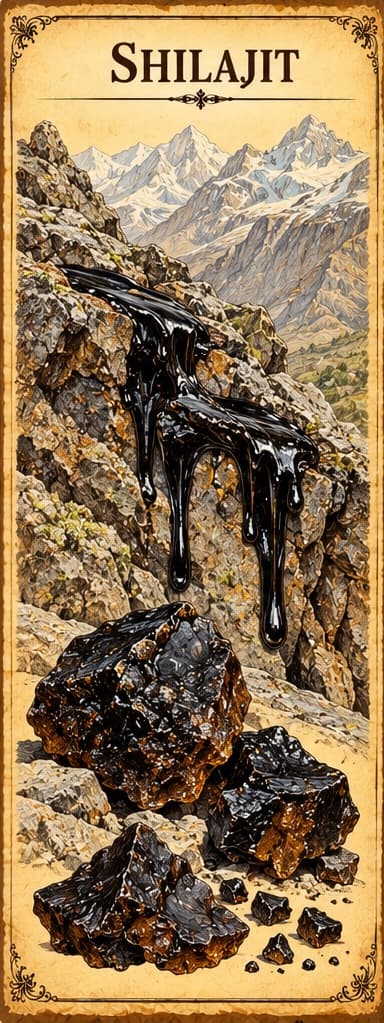
Shilajit
Mineral pitch, a resin-like substance from mountain rocks
A blackish-brown, gummy substance that oozes from rocks in the Himalayas, used in Ayurveda as a rejuvenator. Unpurified shilajit and some products can contain heavy metals and other toxins.
Safety at a glance
- PregnancyNothing recorded
- BreastfeedingNothing recorded
- MedicinesNothing recorded
- Who should avoid itNothing recorded
- AllergiesNothing recorded
- ToxicityNothing recorded
Tap a box to read the safety notes below. “Nothing recorded” means our sources don't cover it, not that it's safe.
What is Shilajit?
- Plant family
- Not a plant: plant material and humus compressed in mountain rocks
- Parts used
- The purified resin
- Where it grows
- The Himalayas at 1,000 to 5,000 meters; also Afghanistan, Nepal, Bhutan, Pakistan, China, Tibet and Russia
Also called
Mineral pitch, Mumiyo
Regional names
Shilajatu
Traditional names
Silajit
Traditionally used for
- Rejuvenation
- Tiredness
- Weakness
- High-altitude problems (traditional)
Traditionally described as
- Rejuvenator (Ayurveda)
Health topics
Where Shilajit appears in symptom search, and why. Being listed doesn't mean it's a proven treatment.
- Fatigue
Traditionally used for tiredness and weakness. In one 8-week trial, 500 mg a day helped stronger young men keep more strength after tiring exercise; a lower dose did nothing.
Traditions that use it
- Ayurveda
Used for centuries as a rejuvenator (rasayana); described in the Charaka Samhita.
Safety
Contamination
Unpurified shilajit may contain mold toxins, heavy metals and other harmful substances, so only purified preparations should be used. Some Ayurvedic products sold online, including shilajit, have been found to contain lead, mercury and arsenic.[1]Study
A 2025 study found thallium, a toxic metal, in natural shilajit (up to 0.226 µg per gram) and in shilajit supplements (up to 0.5 µg per gram). Some supplements had more than raw shilajit. The authors call for regular testing, especially for long-term use.[2]Study
What does the research say?
Traditional use
These are traditional uses, not proven treatments.
Shilajit is a pale-brown to blackish-brown gummy substance that oozes from rocks in the Himalayas between May and July, at 1,000 to 5,000 meters. It's also found in Afghanistan, Nepal, Bhutan, Pakistan, China, Tibet and Russia. It's made of humus and plant material compressed by layers of rock, and contains fulvic acid.
Its Sanskrit name is often translated as "conqueror of mountains and destroyer of weakness". Ayurveda has used it for centuries as a rejuvenator, and it's described in the Charaka Samhita.[3]Study
Supporters recommend it for tiredness, lack of energy and long-lasting fatigue, and for coping with the stresses of high altitude.[3]Study
Research in people
In an 8-week trial, 63 active young men took 250 mg or 500 mg a day of a shilajit product (PrimaVie) or a placebo. Among the stronger half of the men, the 500 mg group lost less leg strength after a tiring exercise and had lower levels of a marker of connective-tissue breakdown. The 250 mg dose did no better than the placebo.[4]Study
Technical detail: randomized, placebo-controlled; 21 per group; percent decline in maximal voluntary isometric contraction 8.9% (500 mg) vs 17.0% (250 mg) and 16.0% (placebo); serum hydroxyproline lower with 500 mg.
In a small study of healthy volunteers, 2 g of shilajit a day for 45 days didn't change blood pressure, pulse, weight or blood counts. Triglycerides and cholesterol fell and HDL ("good") cholesterol rose. There was no comparison group.[5]Study
In short
Unpurified shilajit and some products can contain heavy metals such as lead, mercury, arsenic and thallium.
Sources
- [1] Shilajit: a natural phytocomplex with potential procognitive activity · DOI: 10.1155/2012/674142Peer-reviewed study
- [2] Quantifying of thallium in Shilajit and its supplements to unveil the potential risk of consumption of this popular traditional medicine · DOI: 10.1186/s13065-025-01384-7Peer-reviewed study
- [3] Shilajit: A panacea for high-altitude problems · DOI: 10.4103/0974-7788.59942Peer-reviewed study
- [4] The effects of Shilajit supplementation on fatigue-induced decreases in muscular strength and serum hydroxyproline levels · DOI: 10.1186/s12970-019-0270-2Peer-reviewed study
- [5] Shilajit: evalution of its effects on blood chemistry of normal human subjectsPeer-reviewed study
This information is educational and traditional in nature, and is not a substitute for professional medical advice. Unfamiliar word? See what these words mean.