
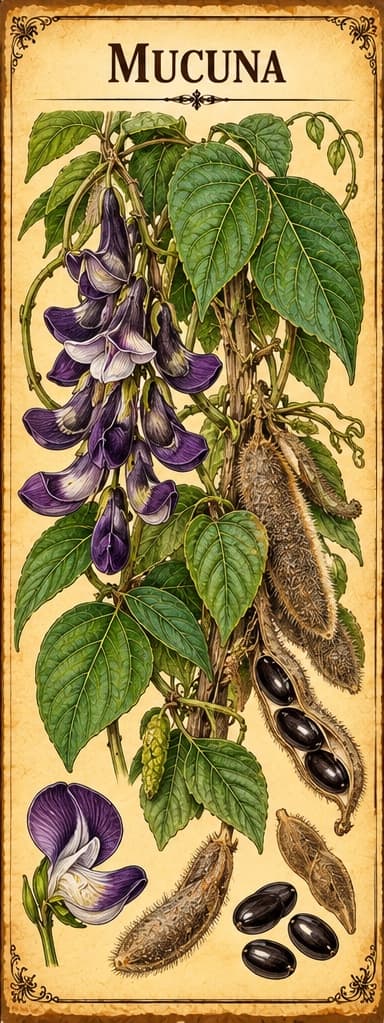
Mucuna
Mucuna pruriens
Velvet bean, a climbing bean whose seeds are a natural source of levodopa, the main Parkinson's medicine. Used in Ayurveda for male infertility, nerve disorders and Parkinson's disease.
Safety at a glance
- PregnancyNothing recorded
- BreastfeedingNothing recorded
- Medicines1 note →
- Who should avoid itNothing recorded
- Allergies1 note →
- Toxicity1 note →
Tap a box to read the safety notes below. “Nothing recorded” means our sources don't cover it, not that it's safe.
Mucuna may interact with some medicines. If you take any medicine, read Interactions with medicines below and talk to your doctor or pharmacist before using it.
What is Mucuna?
- Plant family
- Fabaceae, the pea and bean family
- Parts used
- Mainly the seeds
- Where it grows
- Originally from southern China and eastern India; now grows in tropical areas worldwide
- Genus
- Mucuna
- Species
- pruriens
Also called
Velvet bean, Cowhage, Cowitch
Traditionally used for
- Male infertility
- Nerve disorders
- Parkinson's disease
- Aphrodisiac (traditional)
Traditionally described as
- Natural source of levodopa
Health topics
Where Mucuna appears in symptom search, and why. Being listed doesn't mean it's a proven treatment.
- Fertility
Traditionally used for male infertility. In one study, mucuna seed powder improved sperm count and movement in stressed infertile men; there was no placebo group.
- Sexual Health
Traditional use only: used in Ayurveda as an aphrodisiac.
Traditions that use it
- Ayurveda
Used for male infertility, nerve disorders, as an aphrodisiac, and for Parkinson's disease.
How it's prepared
Common ways Mucuna is prepared or sold. This isn't advice on how to take it; see Safety below.
Safety
Interactions with medicines
Mucuna seeds contain levodopa (L-dopa), the main medicine for Parkinson's disease, at about 0.6% to 6.4% of their dry weight depending on the variety.[2]Study
Allergies
Some types, called cowhage or cowitch, have long stinging hairs on the pods. Touching them causes an intensely itchy rash.[3]Study
Toxicity testing
Unprocessed velvet bean contains levodopa and hallucinogenic compounds (tryptamines), along with substances that block the absorption of nutrients.[3]Study
What does the research say?
Traditional use
These are traditional uses, not proven treatments.
In Ayurveda, mucuna seeds are used for male infertility and nerve disorders, as an aphrodisiac, and even for Parkinson's disease.[3]Study
Laboratory & animal research
Lab and animal results show what might be worth studying in people. They don't show that the herb has these effects in humans.
Mucuna seeds are the best-known natural source of levodopa, the standard medicine for Parkinson's disease. In 56 seed samples of four varieties, levodopa made up 0.6% to 6.4% of the dry weight. In lab tests, about half the levodopa broke down during extraction into compounds that can damage cells.[2]Study
Technical detail: HPTLC densitometry; 0.58–6.42% dry weight; average 52.11% degradation into quinones and reactive oxygen species.
Research in people
In a 2017 trial in Italy, 18 people with advanced Parkinson's disease each took several single-dose treatments in random order. These were standard levodopa medicine, roasted mucuna seed powder at two doses, and a placebo.
The lower mucuna dose worked about as well as the standard medicine, with fewer side effects and fewer involuntary movements. The higher dose worked better and for longer. These were single doses, not long-term treatment. The researchers were studying it as a low-cost option for people who can't afford levodopa medicine.[1]Study
Technical detail: double-blind, randomized, crossover, noninferiority design; mucuna 12.5 and 17.5 mg/kg vs dispersible levodopa 3.5 mg/kg with benserazide; NCT02680977.
In a study in India, 60 infertile men under psychological stress took 5 g of mucuna seed powder a day for 3 months. Their stress levels fell, and sperm count and sperm movement improved. They were compared with healthy fertile men, not with a placebo group.[4]Study
Technical detail: lower serum cortisol and seminal lipid peroxides; restored SOD, catalase, glutathione and ascorbic acid.
In short
The seeds contain levodopa, a strong Parkinson's medicine, and some pods have hairs that cause an intensely itchy rash.
Sources
- [1] Mucuna pruriens in Parkinson disease: A double-blind, randomized, controlled, crossover study · DOI: 10.1212/WNL.0000000000004175Peer-reviewed study
- [2] Levodopa in Mucuna pruriens and its degradation · DOI: 10.1038/srep11078Peer-reviewed study
- [3] The Magic Velvet Bean of Mucuna pruriens · DOI: 10.1016/s2225-4110(16)30119-5Peer-reviewed study
- [4] Mucuna pruriens Reduces Stress and Improves the Quality of Semen in Infertile Men · DOI: 10.1093/ecam/nem171Peer-reviewed study
This information is educational and traditional in nature, and is not a substitute for professional medical advice. Unfamiliar word? See what these words mean.